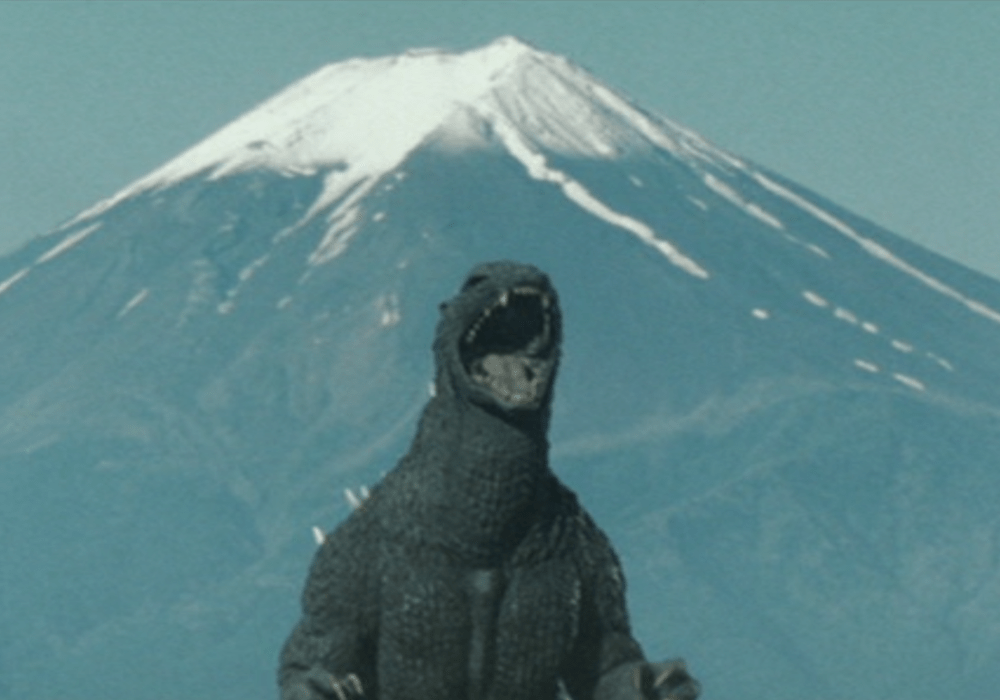
Godzilla: Final Wars (2004)

Fifty years. FIFTY YEARS! Five DECADES worth of Godzilla cinema. It seems so long, but in the context of human civilization, it’s a blink of an eye. Technology during this particular time was rapidly developing, leading to a boom in digital effects. A far cry from the boxy wireframes of the Dire Straits’ Money For Nothin’, CGI had recently been pushed to its limits and used to spectacular effect in major film franchises like The Matrix, The Lord of the Rings, and Harry Potter. So where does that leave Godzilla? For fifty years and seven actors, the King of the Monsters has been portrayed by a guy in a suit. RIP, Kenpachiro Satsuma who recently passed away. Some films have toyed with these new tools, but nothing as pervasive as their Hollywood counterparts. 2004’s Godzilla: Final Wars embraced this debate over digital and practical effects in microcosm, stealing a lot from the Wachowski’s Matrix films in the process.

Godzilla: Tokyo S.O.S. had the poorest box-office haul ever, but there was no way Toho was going to let the 50th anniversary of Godzilla fall by the wayside. The Millennium era hadn’t hit the mark with new audiences, except for a niche few like myself. The franchise was languishing, and numbers drive production. This isn’t the first time Godzilla stared down the barrel of obscurity, and producer Shogo Tomiyama recognized that reality. Toho would produce one last, big, swing-for-the-fences film to mark Godzilla’s anniversary, before going dormant as they had done after Terror of Mechagodzilla and Godzilla vs. Destoroyah, waiting for the next generation to take up the mantle. Enter Ryuhei Kitamura, a young filmmaker bucking the trend of safe, formulaic, cookie-cutter productions that conservative studio execs were going for, but were no longer delivering.

Read More

Godzilla Against Mechagodzilla (2002)

Well, folks, we’re back! I had to take a hiatus to plan a wedding, start a new job, and help run a curling club. One season ends, just in time for another to begin: baseball! Back in 1993, the Yomiuri Giants drafted a kid right out of out of high school. How good was this kid? Well, he originally batted right-handed, but was so good that his brother insisted he start batting left-handed or he’d stop playing with him altogether. So what did this kid do? Only learn how to bat left-handed and become one of the best left-handed hitters in both Japanese and US baseball, winning the Nippon Professional Baseball MVP in 2000, and the MLB MVP of the New York Yankees World Series winning team in 2009. That kid? None other than Hideki “Godzilla” Matsui himself. 2002 saw not only Matsui signing with the Yankees, but also some major advancements in neural engineering. Scientists were able to implant electrodes into a rat’s brain, and by stimulating the left and right whisker sensors, then hitting the pleasure-reward center, were able to control the rat via remote. This allows rescuers to send rats into collapsed rubble, searching for survivors and navigating tight spaces that humans or robots can’t access. It also laid the groundwork for other technologies, restoring brain function and muscle control, inhibiting the urges of addiction, and fighting dementia. This is all well and good, but what are the ethics behind this? Short-lived lab rats are one thing, but what about larger animals? Humans? Could this be applied to create a living weapon? And what happens when the technology inevitably fails on that weapon? These are the questions that 2002’s Godzilla Against Mechagodzilla raises in the first of two entries in Toho’s “Kiryu Saga.”

Read More

Godzilla 2000: Millennium (1999)

How crazy is it that in 2017, a former special agent and Pentagon employee leaked evidence that the US Military had on UFOs and the investigations into them, to very little fanfare? It barely made headlines, and was just churned through the 24 hour news cycle and forgotten, pending further investigation. Where did our fascinations with UFOs go? You can find alien trends in popular culture at various points, from War of the Worlds (the book, 1898) to War of the Worlds (the radio broadcast, 1938) to War of the Worlds (the movies, 1953, 2005). For anyone older than 25, UFOs were a major part of life, permeating our entertainment in nearly every genre, and even if you didn’t believe in little green men from far off galaxies barnstorming the skies and probing rednecks, you were guaranteed to at least know someone who did. Part of the reason this major story didn’t make many waves was because of the outrage overload from 2016-2020. It’s easy to get lost in a sea of news when twice a day you had a story coming out of the White House that was the most ludicrous thing you’d ever heard. But another part, especially in an age of people wary of fake news, is there really isn’t any evidence to say “Yes, those were aliens.” The Pentagon report doesn’t rule out the possibility, but stresses that there is no solid evidence for extraterrestrial technology. It really takes the wind out of the sails, but UFOs are, by very definition, “unidentified.” Another reason I’d posit, is that UFOs in pop culture tend to represent the unknown and the other. With the advent of the internet, we became a much more connected world. Many stopped seeing others from foreign nations and far-off lands as the “other” or “them;” strange, curious beings beyond reach or understanding. Especially if you lived in a small town, and never travelled abroad, you may never have met or conversed with someone from China, Ghana, Austraila, or Peru. It could seem like various cultures were far more different than they were similar. The internet changed all that. You could connect with anyone, and suddenly had access to local news from around the country, or the world, complete with updates and retractions, and the ability to cross check references. The 90s seemed to be the last hurrah of the weird, cryptid, UFO, crystal energy, astrology, ghost, possession, spontaneous combustion, type of fun conspiratorial fascination. Which is not to say conspiracy theories disappeared, just that they’re a lot more sad, disappointing, (relatively) grounded, and politically motivated. Image and video resolutions also became much clearer, making it harder to fake “evidence,” and you had more people collaborating digitally to find the truth and debunk hoaxes. It was much easier to believe there were more things in heaven and earth before we started documenting every little occurrence for all to see on the internet. But what a time to be alive! 1996 gave us both Independence Day, and Mars Attacks! In 1997, we got the adaptation of Carl Sagan’s Contact with Jodie Foster, alongside Will Smith and Tommy Lee Jones’ unforgettable Men In Black. Not to mention David Duchovny and Gillian Anderson’s seminal run of the X-Files. It was a decade of change, the dawn of the global information age, those who grew up around that time experienced the transition from cassette tapes to CDs to mP3s in a whirlwind of advancement, with film evolving on a similar track. This is the environment in the year 1999 with the Y2K bug looming on the horizon, eve of a new millennium, that Godzilla 2000 sprang to life.

Read More