Godzilla vs. Destoroyah (1995)

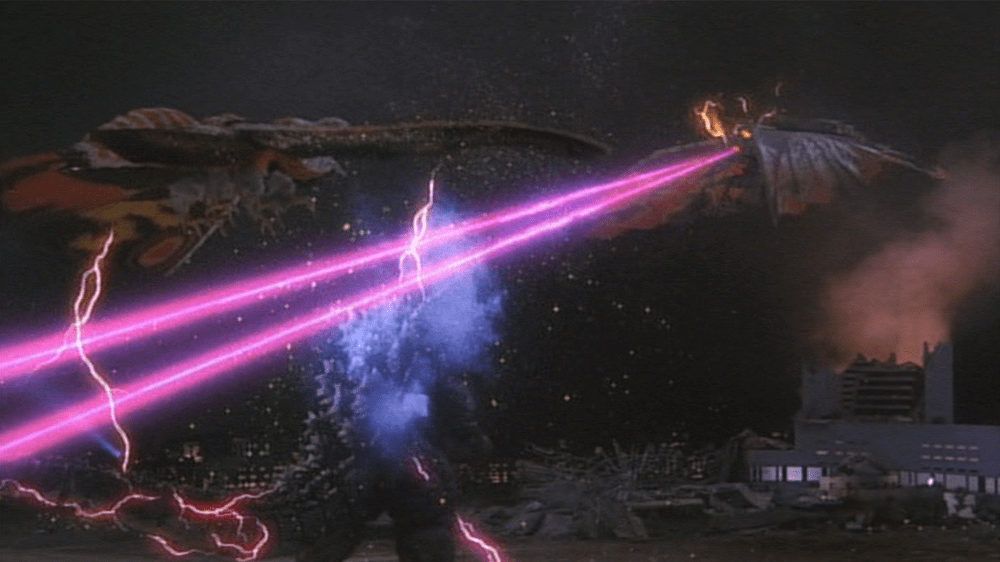
Well folks, we’re up to the end of the Heisei era, and what a time to get there. 1995’s Godzilla vs. Destoroyah was billed as the death of Godzilla, putting an endcap on the iconic series. Everyone involved (and any comics fans) knew that this would likely not be the case, but they were closing up shop and filming the final chapter of the current run. In a series of poetic homages to the original Godzilla, Destoroyah revives the core themes that have made the franchise so impactful and successful to this day. Godzilla is dying, after having taken on a massive amount of radiation, and is approaching meltdown. The existential threat looms large: the clock is ticking, and if we don’t do something, it could mean the end of life on planet Earth. A timely lesson, considering the events of the past week (as of writing this, March 3 2022). With Vladimir Putin straight up invading the sovereign nation of Ukraine, the rest of the world is faced with some of the most difficult global security decisions since WW2. Any direct intervention could push Putin into launching a nuclear first strike, as he’s threatened to do, which is limiting the United States and Europe to offering financial, medical, and military supply aid rather than committing troops. While it’s extremely unlikely that this could happen, do you want to call that bluff? Only time will tell, as events are still unfolding. To make matters worse, everyone considers themselves to be an armchair expert on every current topic thanks to the internet, which leads to a bunch of dweebs on Twitter saying a nuclear war wouldn’t “actually be that bad.” I’m not claiming to be an expert, but can lay out a few points as far as I understand them. The folks saying this are making a pile of assumptions: one is that there was a study on recent wildfires showing that ash was rising far higher into the atmosphere than was previously modeled, indicating the dangers of a nuclear winter could be worse than originally expected. However, another study indicated that this was probably not the case, so the science is undecided there. The next is that targeting and delivery systems have become far more advanced allowing for more “precision” to annihilate a target. In the height of the cold war, it was assumed that many warheads would be aimed at a single target, and it’s more likely that only a few would be need in the modern age, reducing the total amount fired, and therefore limiting the dangers of a nuclear winter. This seems to be a uhhh, very generous assumption given that defense systems have also become more advanced. Not something I’d like to gamble on. It also ignores some key concepts of nuclear war. While the nuclear winter may be more localized and not immediately plunge the world into a life-ending apocalyptic disaster, the massive swaths of land that would be effected would destroy food production effecting billions. The radioactive fallout would drift and corrupt everything in the surrounding area, civilization and wildlife alike. Even if you were outside the blast zone, there’s a sizable radiation zone where you would need immediate medical attention – and not be able to get it. Infrastructure would collapse, and first responders would not be able to risk exposure leaving millions to die slow agonizing deaths over the coming days and weeks. Being more connected by digital technology than ever before means communications systems going down, including banking systems, would plunge entire economies into chaos. Does this mean you should you keep a large stack of cash under a mattress? Probably not, even with heightened tensions, the threat of a house fire is still far more likely. Last but not least: the immense human cost. Yes, humanity itself may be likely to survive a “small” nuclear war, but initiating it, or even retaliating with nuclear weapons, would turn you into the biggest mass murderers in modern history in the blink of an eye. Not just those effected in the blasts and immediate aftermath, but the cancers and sickness that would effect surrounding regions and waterways for decades. We see the effects rippling throughout generations in Godzilla vs. Destoroyah. The farther we get from the living memory of Hiroshima and Nagasaki, the more you see people downplaying these risks, or bringing up old justifications, and that’s a depressing and terrifying thought.

Read More
Godzilla vs. Mechagodzilla II (1993)

By the early 90s there were two huge crazes running rampant through the minds of the world’s youth. The 80s brought a resurgence of robot obsessions with Transformers and Gundam, but equally if not more enticing was the concept of DINOSAURS. Growing up in the 80s and 90s, I had caught dino fever from an early age. My parents graciously got every Rupert Oliver dinosaur book which detailed the environment and diet of different species, and told a story for each one that made learning engaging. I had a set of about 100 cards with realistic dinosaur illustrations and impossibly small text packed full of information on each one. These are a few of the things that taught me how to read. Movies and TV shows tapped into this interest with Land Before Time, Dino-Riders, and even Barney and Friends. But those were all small potatoes compared to what was to come in 1993. A legendary director would use skillful practical effects to spin a tale of genetic engineering gone wrong. That’s right, 1993 was the year Roger Corman’s Carnosaur came out! Just kidding; while Corman’s low-budget schlocky horror flick did release a few weeks prior, Spielberg’s Jurassic Park mesmerized audiences with some of the best effects ever seen and changed film forever. While Jurassic Park is inarguably a better movie, arguably one of the best films ever made, I still have a soft spot for Carnosaur. It is not good, but it is way off the deep end, the effects are fun, and for an 11 year old kid was excitingly violent and gory. And for anyone who appreciates practical effects on a low budget, Roger Corman was one of the best. It’s worth watching his films if for nothing else than to appreciate how far he could stretch a dollar, and how many greats were graduates from the “Roger Corman Film School.” Not an official organization, but Corman was an independent pioneer who worked with and influenced Francis Ford Coppola, James Cameron, Jack Nicholson, Ron Howard, Martin Scorcese, Joe Dante and many others. Joining Spielberg and Corman in the ’93 dinosaur rampage through the silver screen was returning director Takao Okawara in Godzilla vs. Mechagodzilla II.

Read More

Godzilla vs. Mothra (1992)

Hot on the heels of 1991’s Godzilla vs. King Ghidorah, Toho wanted to keep the momentum and release another kaiju movie. They had finally found success, despite overseas criticism, and were ready for more. While Kazuki Ōmori wouldn’t be returning in the director’s chair, he did pen the screenplay, and continued to draw on big American action hits, this time Indiana Jones. The Last Crusade came out 3 years prior, and was massively toned down from the previous film Temple of Doom in 1984. This, incidentally, came out the same year as Joe Dante’s Gremlins (released in the middle of summer for some reason?) and the wombo-combo of two supposedly family movies with graphic violence led to the creation of the PG-13 rating. It doesn’t have much to do with the Godzilla films, which largely go unrated in America, but it’s still kinda neat. The other major influence to Godzilla vs. Mothra takes us back to 1987. Like a Godzilla film, our story starts at sea! The barge Mobro 4000, holding over three tons of garbage and tugged by the Break of Dawn set sail on March 22, 1987. The plan was to ship the garbage down to North Carolina, where it would be converted to methane as it decomposed. This was a new concept, and the shipping endeavor was partially financed by mob boss Salvatore Avellino, who would later be imprisoned for killing two garbage haulers. Like some cruel April Fool’s joke, it was denied port when it finally arrived at its destination on the 1st. Someone had spotted a bedpan in the garbage, and surmised that there would be hazardous medical waste that contaminated the entire load. As the story broke, it was framed as the fancy elite of New York City dumping their trash all of the poor working class folks of the South. The Mobro spent two months at sea being chased out of harbors by not only US Coast Guards but the navies of Mexico and Belize as well. It ended up back in New York to be incinerated, and the international incident spurred a renewed awareness of the world’s garbage disposal crisis, and an uptick in environmental activism. In the next few years, recycling programs grew and inspired the series Captain Planet and the Planeteers in 1990, which in turn inspired a foundation to get kids involved with Earth-friendly sustainability projects. So with this newfound focus on environmentalism, who better to return to the Godzilla series than the champion of Earth and the environment than Mothra herself?

Read More