Godzilla: Tokyo S.O.S. (2003)

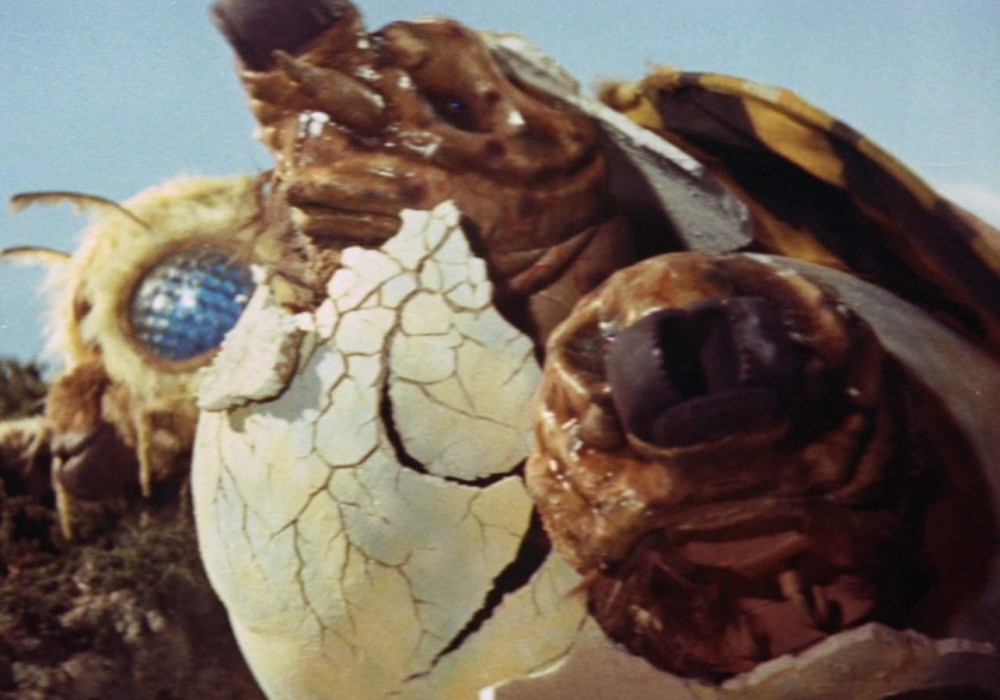
Well, it’s springtime, there’s a still a chill in the air though not as harsh as we’ve felt these past months. The softening of the climate is making way for budding bushes and flowers, birds are returning, bees and bears alike awakening from hibernation, life is coming back into the world. In 1997, a new life in particular was brought to the world, a new kind of life. With the birth of Dolly the sheep, bioengineering produced the first mammalian clone. She lived for six years, not very long all things considered, but long enough to be impressed with the technology. The intervening years saw advancements, and as Dolly shuffled off this mortal coil, Banteng #1 gifted us with her presence. She was one of two who were born in 2003, the first endangered species clones to survive more than a few days. Banteng #1 lived a healthy life for 7 years. The purpose of cloning endangered animals isn’t necessarily to replace them via that method alone. Species become threatened when their habitat is disrupted, and that needs to be addressed first and foremost. What cloning can do, is help the species along its way, bide some time, and perhaps in the future add genetic resistance and biodiversity when their numbers have dwindled to the point where rebuilding the population would only produce offspring from a small set of ancestors. The question remains: do we have a right to tamper in God’s domain? Dear readers, you should know by now that when themes of death and rebirth come a knockin’, Our Lady of Mercy, the Massive Mighty Mother of Gaia, Patron Saint of Aerial Ass Whoopin’s, the benevolent Mothra herself will not be far behind.

Read More
Godzilla, Mothra, and King Ghidorah: Giant Monsters All-Out Attack (2001)

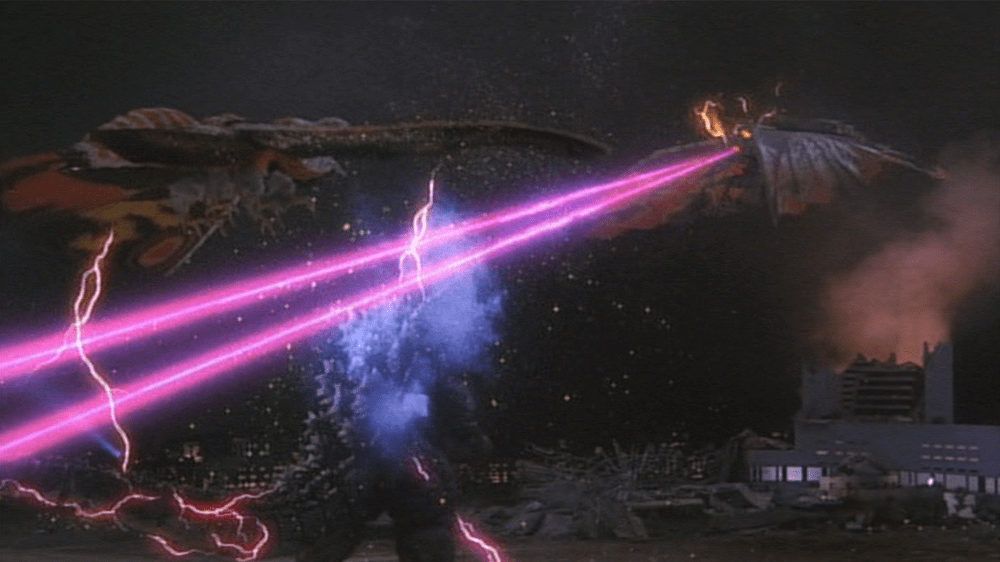
Since its inception in 1954, the Godzilla has been varying degrees of an allegory about the horrors of war. Ishirō Honda wanted the world to see the massive devastation, illness, and civilian impact of the atomic bombs, and warn the human race against continuing down such a destructive path. While it’s completely fair to call out the U.S. for this war crime and and accelerating the threat to end all life on the planet, most movies completely ignore Japan’s role in the events that lead up to Hiroshima and Nagasaki. Despite what Godzilla vs. King Ghidorah may have you believe, allying with the Nazis and committing atrocities on the Korean peninsula is not something to wax nostalgic about. In addition to killing military personnel and civilians alike in the attack on Pearl Harbor, the Imperial Japanese Army abducted thousands of women forcing them into sexual slavery across southeast Asia. The Japanese government long denied the existence of these “comfort women” and “comfort stations,” but an apology was eventually issued in 1993. That, however spurred a backlash among right-wing nationalists in Japan, notably former Prime Minister Shinzo Abe who would later sign an agreement to donate money to the victims in South Korea, but insist that they stop using the term “sex slaves” and remove the memorial statue from its location in front of the Japanese Embassy in Seoul. Essentially this was international hush money. This nationalist movement also led to increasing calls to abolish or reinterpret Article 9 of Japan’s constitution which essentially waives the country’s right to declare war. The wording comes in two parts, first renouncing the threat of force to settle disputes, and second that land, sea, and air forces shall never be maintained. Some view the JSDF itself as unconstitutional based on that wording, but Japan’s supreme court determined the country does have a right to maintain forces to defend itself. Still, the country continues to push the envelope, ruling it has the right to assist allies in foreign conflicts, starting with the War in Iraq. In 2014, Article 9 was officially “reinterpreted” to allow this, but bypassed the constitutional procedure to do so. It’s along this path of ramped up nationalism and militarism eschewing the Japanese constitution that 2001’s Godzilla, Mothra, and King Ghidorah: Giant Monsters All-Out Attack gives us a unique interpretation of Honda’s anti-war legacy.

Read More

Godzilla vs. Mothra (1992)

Hot on the heels of 1991’s Godzilla vs. King Ghidorah, Toho wanted to keep the momentum and release another kaiju movie. They had finally found success, despite overseas criticism, and were ready for more. While Kazuki Ōmori wouldn’t be returning in the director’s chair, he did pen the screenplay, and continued to draw on big American action hits, this time Indiana Jones. The Last Crusade came out 3 years prior, and was massively toned down from the previous film Temple of Doom in 1984. This, incidentally, came out the same year as Joe Dante’s Gremlins (released in the middle of summer for some reason?) and the wombo-combo of two supposedly family movies with graphic violence led to the creation of the PG-13 rating. It doesn’t have much to do with the Godzilla films, which largely go unrated in America, but it’s still kinda neat. The other major influence to Godzilla vs. Mothra takes us back to 1987. Like a Godzilla film, our story starts at sea! The barge Mobro 4000, holding over three tons of garbage and tugged by the Break of Dawn set sail on March 22, 1987. The plan was to ship the garbage down to North Carolina, where it would be converted to methane as it decomposed. This was a new concept, and the shipping endeavor was partially financed by mob boss Salvatore Avellino, who would later be imprisoned for killing two garbage haulers. Like some cruel April Fool’s joke, it was denied port when it finally arrived at its destination on the 1st. Someone had spotted a bedpan in the garbage, and surmised that there would be hazardous medical waste that contaminated the entire load. As the story broke, it was framed as the fancy elite of New York City dumping their trash all of the poor working class folks of the South. The Mobro spent two months at sea being chased out of harbors by not only US Coast Guards but the navies of Mexico and Belize as well. It ended up back in New York to be incinerated, and the international incident spurred a renewed awareness of the world’s garbage disposal crisis, and an uptick in environmental activism. In the next few years, recycling programs grew and inspired the series Captain Planet and the Planeteers in 1990, which in turn inspired a foundation to get kids involved with Earth-friendly sustainability projects. So with this newfound focus on environmentalism, who better to return to the Godzilla series than the champion of Earth and the environment than Mothra herself?

Read More

Destroy All Monsters (1968)

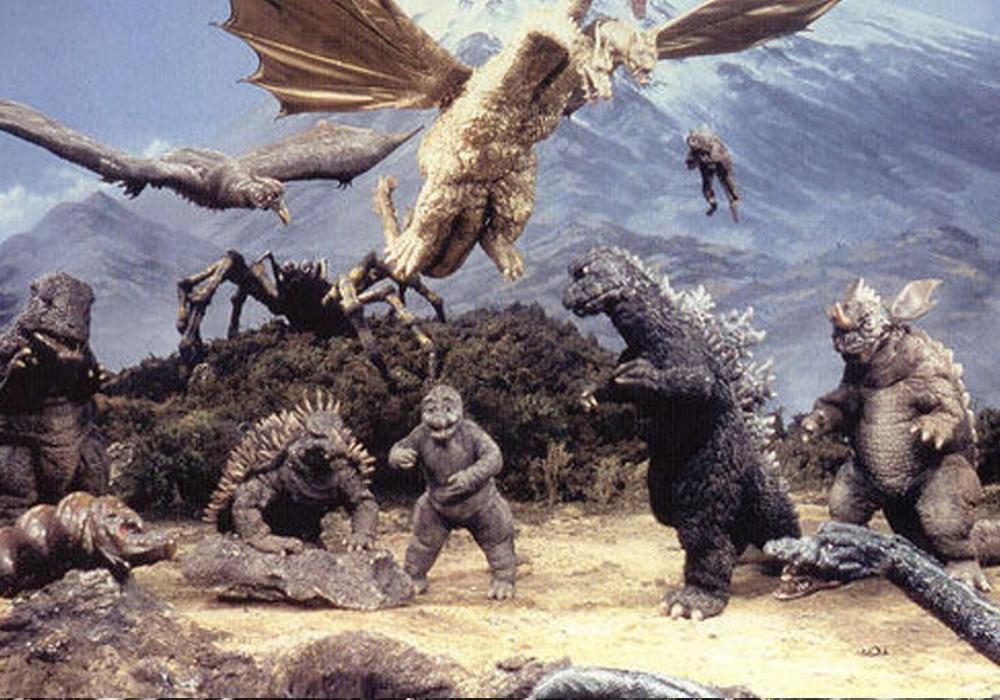
The end. Video, that mad killer, was at it again. Not content with the Radio Star, it set its sights on the kaiju eiga genre. With an expansion of variety and programming broadcast directly into people’s homes, Japan’s film industry was on a decline. And an obvious place to cut costs were special-effects heavy films like the Godzilla franchise. Props, sets, models, costumes, and post-production effects all add up, no matter how cheesy they may seem in retrospect. And so rang the the death knell for Godzilla. Deciding to go out with a bang, producer Tomoyuki Tanaka got director Ishiro Honda back together with composer Akira Ifukube and special effects supervisor Eiji Tsuburaya for 1968’s monster melee hit Destroy All Monsters. Sporting a total of eleven monsters, this film showcases all of Toho’s other creatures that never found their way into a Godzilla film like Varan, Manda, Gorosaurus, and Baragon. The team definitely went all-out for this last hurrah.

Read More

Ebirah, Horror of the Deep (1966)

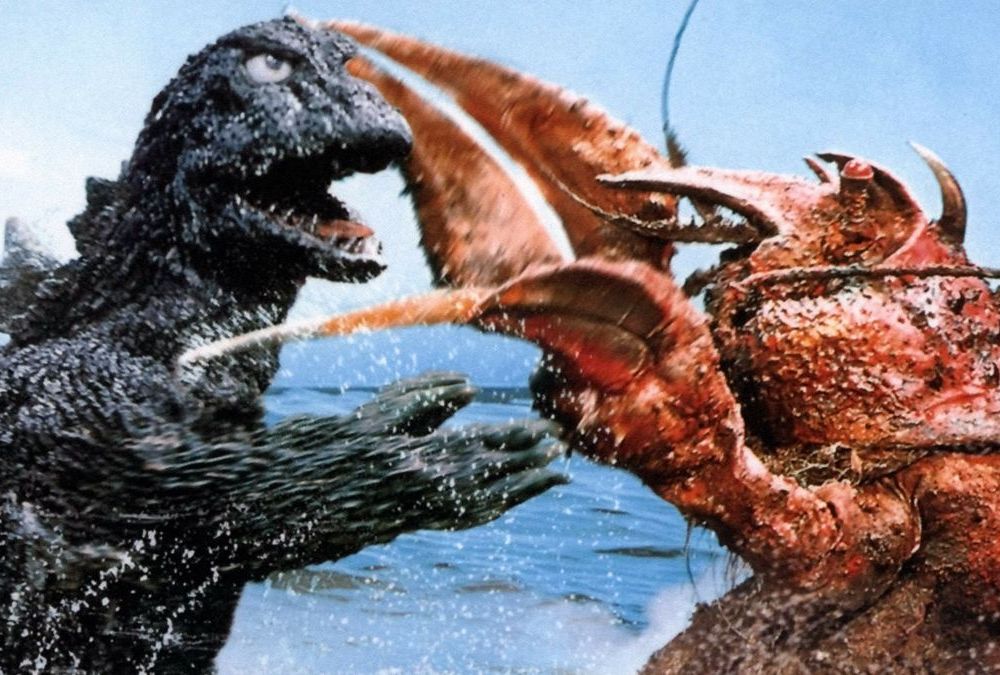
The room is dimly lit, with no windows. It’s a hot summer night, and the rumbling murmur of 600 or so separate conversations fills the air. It’s an eclectic crowd that’s gathered here in front of the downstairs stage at the Middle East in Cambridge, Massachusetts. Aging townies with bandannas, young punks with patches covering jean vests, old punks running out of places to get new tattoos, middle aged moms out for the evening. Sipping a ten-dollar rum and coke out of a plastic cup through a drink stirrer, the lights dim, and people cheer. Low, loud guitar with thick reverb pulses through the air, through your very bones. The Lebanese-American legend and surf rock pioneer Dick Dale has captivated yet another audience in the tail end of a long, successful career. You’ve definitely heard him, if from nothing else then from “Misirlou,” the iconic tune in 1994’s Pulp Fiction. After learning the trumpet and ukulele, he bought his first guitar from a friend for just $8 – spaced out over multiple payments of 25-50 cents each. Even after gaining fame and traveling the world, Dick called Quincy, MA home for decades and I’m fortunate enough to have seen him live a few times. He was one of the first to use heavy reverb that defined a genre and inspire movies like Beach Party, and Muscle Beach Party (both of which featured Dick playing himself as well as the guitar), Endless Summer, Beach Blanket Bingo, and of course Horror of Party Beach. This twangy new sound leant itself to the James Bond theme too, and both surf rock and 007 homages are slathered all over Ebirah, Horror of the Deep like a thick layer of SPF 30.

Read More

Ghidorah, the Three-Headed Monster (1964)

1964. The Vietnam war heats up. President Kennedy had been shot a year prior, and currently the Civil Rights Act was passing in the States. 36 people died in an earthquake that struck the city of Niigata. The Olympic Games are being held in Tokyo. Survivors of Hiroshima had recently lost a case against the government that requested reparations, saying Japan had unduly waived the right to negotiate reparations from the US Government. And none of this has any bearing on Ghidorah, the Three-Headed Monster (1964). No, this film has some small climate change metaphors but is entirely focused on Having A Good Time, much to the chagrin of director Ishiro Honda.

Read More

Mothra vs. Godzilla (1964)

Japan’s economic engine in the 1960s stemmed from the Korean war a decade prior. In an economically depressed postwar nation, acting as a staging area for UN troops to fight the ubiquitous threat of communism kick-started a massive transformation across the country. With many industrial centers being destroyed in WWII, Japan was able to rebuild with the latest technology and politically invested in robust economic expansion. The nation saw agricultural, rural population move from 85% prewar, to 50% in 1945, to just 20% by the 60s. The country shifted focus towards production of high-quality consumer products and urban infrastructure. While this rising tide did indeed lift all ships, it wasn’t without flaws or social cost. Japan is unique in being one of the only collective capitalist nations, relying on tight-knit business relationships, companies owning shares in each other, creating cartels that control the supply chain from manufacture to distribution, and deeply embedded government partnerships. The cronyism and rampant greed are on full blast here in 1964’s Mothra vs. Godzilla.

Read More

Mothra (1961)

At the turn of the 20th century, new advances in technology shocked the world and connected us more than ever. Rapid expansion of the railroads gave manufacturers access to a wealth of raw materials and before long the popularization of automobiles and the combustion engine made travel more accessible to more people all over. The Wright Brothers’ first flight in Kitty Hawk in 1903 would lead to mankind’s access to the skies, and with it, access to some of the last untouched places on earth. Paired with the development of film, small portable cameras, and recording equipment, an interest in anthropological expeditions boomed to bring strange sights and reports of native customs to audiences around the globe. Adventures to pre-industrial tribes were popularized in pulp novels and magazines, and influenced film and television for decades to come. Taking more than a few queues from 1933’s King Kong, it is in this wondrous, curious, and exploitative vein that brings us Ishiro Honda’s 4th kaiju installment: Mothra. (His 3rd after Godzilla and Rodan being Varan The Unbelievable… a story for another time).

Read More