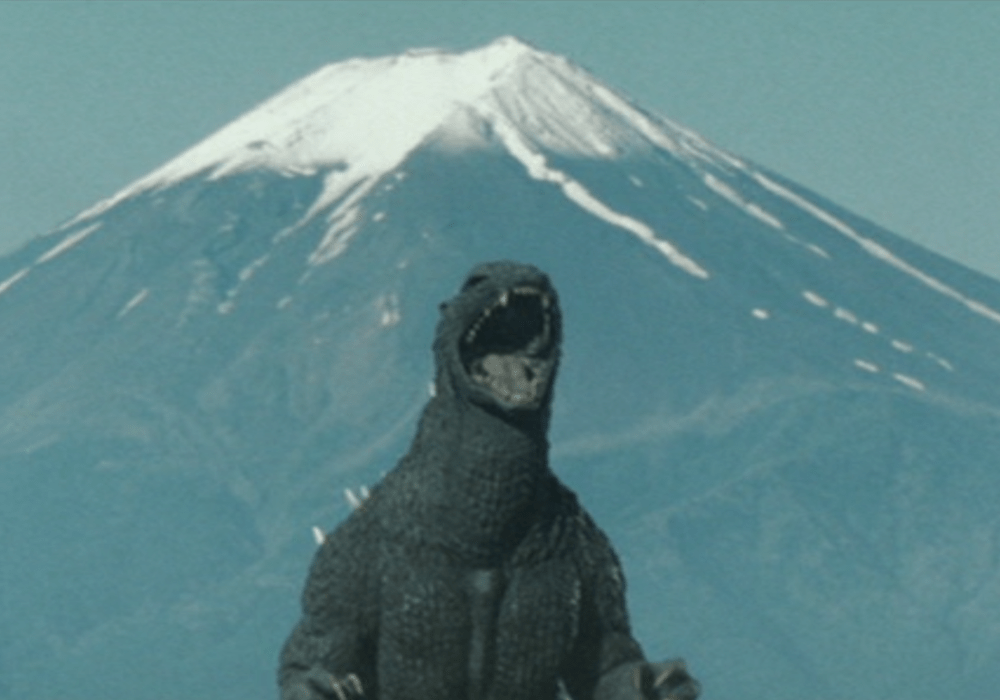
Godzilla: Final Wars (2004)

Fifty years. FIFTY YEARS! Five DECADES worth of Godzilla cinema. It seems so long, but in the context of human civilization, it’s a blink of an eye. Technology during this particular time was rapidly developing, leading to a boom in digital effects. A far cry from the boxy wireframes of the Dire Straits’ Money For Nothin’, CGI had recently been pushed to its limits and used to spectacular effect in major film franchises like The Matrix, The Lord of the Rings, and Harry Potter. So where does that leave Godzilla? For fifty years and seven actors, the King of the Monsters has been portrayed by a guy in a suit. RIP, Kenpachiro Satsuma who recently passed away. Some films have toyed with these new tools, but nothing as pervasive as their Hollywood counterparts. 2004’s Godzilla: Final Wars embraced this debate over digital and practical effects in microcosm, stealing a lot from the Wachowski’s Matrix films in the process.

Godzilla: Tokyo S.O.S. had the poorest box-office haul ever, but there was no way Toho was going to let the 50th anniversary of Godzilla fall by the wayside. The Millennium era hadn’t hit the mark with new audiences, except for a niche few like myself. The franchise was languishing, and numbers drive production. This isn’t the first time Godzilla stared down the barrel of obscurity, and producer Shogo Tomiyama recognized that reality. Toho would produce one last, big, swing-for-the-fences film to mark Godzilla’s anniversary, before going dormant as they had done after Terror of Mechagodzilla and Godzilla vs. Destoroyah, waiting for the next generation to take up the mantle. Enter Ryuhei Kitamura, a young filmmaker bucking the trend of safe, formulaic, cookie-cutter productions that conservative studio execs were going for, but were no longer delivering.

Read More

Godzilla, Mothra, and King Ghidorah: Giant Monsters All-Out Attack (2001)

Since its inception in 1954, the Godzilla has been varying degrees of an allegory about the horrors of war. Ishirō Honda wanted the world to see the massive devastation, illness, and civilian impact of the atomic bombs, and warn the human race against continuing down such a destructive path. While it’s completely fair to call out the U.S. for this war crime and and accelerating the threat to end all life on the planet, most movies completely ignore Japan’s role in the events that lead up to Hiroshima and Nagasaki. Despite what Godzilla vs. King Ghidorah may have you believe, allying with the Nazis and committing atrocities on the Korean peninsula is not something to wax nostalgic about. In addition to killing military personnel and civilians alike in the attack on Pearl Harbor, the Imperial Japanese Army abducted thousands of women forcing them into sexual slavery across southeast Asia. The Japanese government long denied the existence of these “comfort women” and “comfort stations,” but an apology was eventually issued in 1993. That, however spurred a backlash among right-wing nationalists in Japan, notably former Prime Minister Shinzo Abe who would later sign an agreement to donate money to the victims in South Korea, but insist that they stop using the term “sex slaves” and remove the memorial statue from its location in front of the Japanese Embassy in Seoul. Essentially this was international hush money. This nationalist movement also led to increasing calls to abolish or reinterpret Article 9 of Japan’s constitution which essentially waives the country’s right to declare war. The wording comes in two parts, first renouncing the threat of force to settle disputes, and second that land, sea, and air forces shall never be maintained. Some view the JSDF itself as unconstitutional based on that wording, but Japan’s supreme court determined the country does have a right to maintain forces to defend itself. Still, the country continues to push the envelope, ruling it has the right to assist allies in foreign conflicts, starting with the War in Iraq. In 2014, Article 9 was officially “reinterpreted” to allow this, but bypassed the constitutional procedure to do so. It’s along this path of ramped up nationalism and militarism eschewing the Japanese constitution that 2001’s Godzilla, Mothra, and King Ghidorah: Giant Monsters All-Out Attack gives us a unique interpretation of Honda’s anti-war legacy.

Read More

Godzilla vs. King Ghidorah (1991)

What does the 90s superhit American sitcom Friends have to do with Godzilla? Absolutely nothing. But in a small coincidence, our story today starts with a man by the name of Matthew Perry. No, not Chandler, but a naval officer around the year 1853. Known as the “Father of the Steam Navy,” Perry advocated for technical education of naval officers and modernization of the US Naval fleet. Prior to 1853, Japan had implemented an isolationist policy, cutting off all trade from the outside world with the exception of the Netherlands and China, and then only through the port at Nagasaki. The reason being was twofold: they saw what had happened in China with the Opium Wars, fought over trade disputes, and how much British traders brought in contraband opium and the corruption of local officials. (The first Opium War was how China lost Hong Kong to Great Britain by the way). The other was to halt the spread of Catholicism, and if you thought Catholics were pushy today, it’s nothing compared to the Manifest Destiny days. By securing the country against outside influence and controlling trade, the shogunate hoped to preserve Japanese culture and prevent any individual governor from becoming powerful enough to overthrow them. That all came to a halt when Commodore Matthew Perry sailed into what would become Tokyo Bay on his badass upgraded steam-powered battleship, insisting a letter be delivered to the leader of the country at the time, the shogun Tokugawa. After being told to piss off and head to Nagasaki, Perry shelled some buildings and the letter was delivered, outlining demands for Japan to open up trade with the US. Perry returned the following year to sign a lopsided treaty ensuring favorable terms for the US, a result of the “gunboat diplomacy.” Seeing what had happened to China, and following this aggressive strategy from the US, Japan knew it had some catching up to do or else it would be weakened or destroyed by the West. Looking to the global powers of that time, they sought to emulate their models of advancement which included imperialism fueling industrialization. Still with me? Hang in there, this pales in comparison to the plot loops of Godzilla vs. King Ghidorah.

Read More