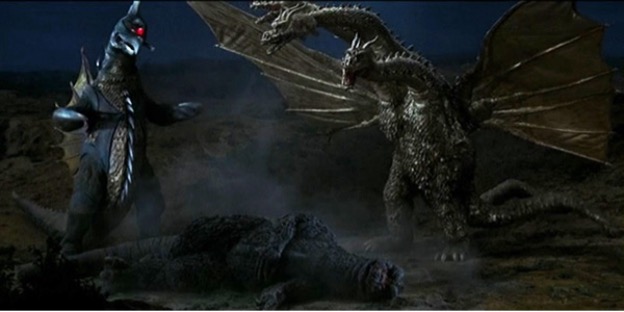
Godzilla vs Gigan (1972)

It’s a shame producer Tomoyuki Tanaka disliked 1971’s Godzilla vs. Hedorah so much. The following year, after recovering from illness, he set out to get the Godzilla franchise back to basics. With Japan’s film industry in steady decline, the budgetary woes continued for Toho. The rise in popularity of television and big-budget imports from Hollywood lead to the Japanese studios cutting corners all over the place. In a few years, 1975 would mark Japanese-made films falling to below 50% market share. Like All Monsters Attack, Gigan relies heavily on stock footage, though a new monster was created for this one, and man does it rock. In another cheap move, they also use recycled music from Akira Ifukube’s other movies for the score, and uh, yeah, occasionally that works out. Jun Fukuda helms the project as director, seeking to right the ship, and special effects director Teruyoshi Nakano is back for round two after his spectacular work with Hedorah. The Godzilla suit from Destroy All Monsters is used for the fourth time, and sadly this will be the final film Haruo Nakajima will play Godzilla. Nakajima has been with us from film one, bringing Godzilla’s familiar mannerisms to life, and he will be missed.

Read More
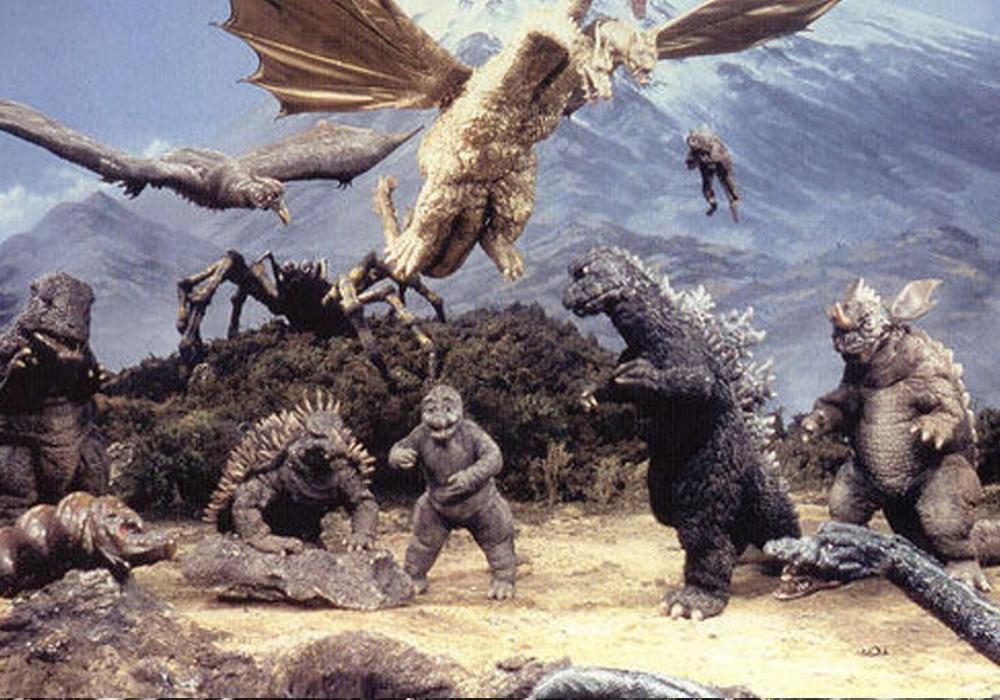
Destroy All Monsters (1968)

The end. Video, that mad killer, was at it again. Not content with the Radio Star, it set its sights on the kaiju eiga genre. With an expansion of variety and programming broadcast directly into people’s homes, Japan’s film industry was on a decline. And an obvious place to cut costs were special-effects heavy films like the Godzilla franchise. Props, sets, models, costumes, and post-production effects all add up, no matter how cheesy they may seem in retrospect. And so rang the the death knell for Godzilla. Deciding to go out with a bang, producer Tomoyuki Tanaka got director Ishiro Honda back together with composer Akira Ifukube and special effects supervisor Eiji Tsuburaya for 1968’s monster melee hit Destroy All Monsters. Sporting a total of eleven monsters, this film showcases all of Toho’s other creatures that never found their way into a Godzilla film like Varan, Manda, Gorosaurus, and Baragon. The team definitely went all-out for this last hurrah.

Read More

Invasion of Astro-Monster (1965)

In 1964, we received a strong message on the importance of international cooperation in Mothra vs. Godzilla, and a year later Toho Studios was practicing what they had preached. Invasion of Astro-Monster was one of three co-productions with US producer Henry G. Saperstein, who claimed to provide half the funding, yet budget restrictions still forced a few shortcuts along the way. In spite of these, Invasion of Astro Monster is a fun beautiful romp and the first in the franchise to introduce an alien race. There’s a whole lot of sci-fi DNA throughout the film, so if you’ve branched out beyond the Godzilla franchise, you’ll recognize some nods to those who came before.

Read More

Ghidorah, the Three-Headed Monster (1964)

1964. The Vietnam war heats up. President Kennedy had been shot a year prior, and currently the Civil Rights Act was passing in the States. 36 people died in an earthquake that struck the city of Niigata. The Olympic Games are being held in Tokyo. Survivors of Hiroshima had recently lost a case against the government that requested reparations, saying Japan had unduly waived the right to negotiate reparations from the US Government. And none of this has any bearing on Ghidorah, the Three-Headed Monster (1964). No, this film has some small climate change metaphors but is entirely focused on Having A Good Time, much to the chagrin of director Ishiro Honda.

Read More