
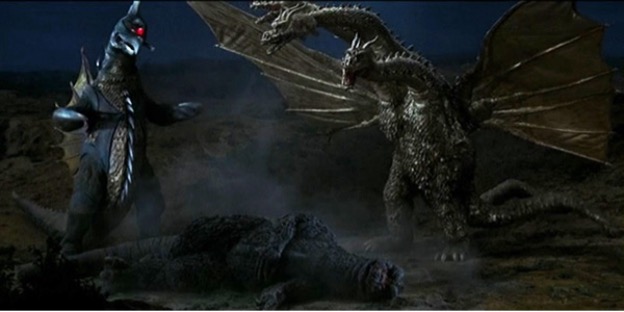
Godzilla vs SpaceGodzilla (1994)
The birth of hip hop can be traced back to the 1970s in the Bronx, New York, New York, America. DJ Kool Herc pioneered a turntable technique of isolating and repeating musical breaks. The genre started small, only available at block parties, house parties, and schoolyards. Young people would bring out a boombox and start rhyming, improvising intricate poetry on the fly. By the 80s, the genre became popularized enough to sell records from greats like Kurtis Blow, Grandmaster Flash, Doug E. Fresh, and way more than I can list here. In retrospect it shouldn’t be surprising, but a prevailing casual racist belief among older white people was that it was music for uneducated thugs who didn’t have the best grasp on the English language. It’s an absolutely insane take considering the craftsmanship and grasp of rhythm, cadence, and structure required to spit fire, be it freestyle or pre written. The backlash against “ebonics” or African American English would come to a head in 1996 with Oakland School Board’s resolution to recognize the legitimacy of Ebonics and incorporate that into teaching standard English in the classrooms. As you can imagine, white people lost their friggin minds over this without understanding the actual resolution or its impact on education. Meanwhile, overseas, Japan was picking up on this new musical style, but fans felt that hip hop was more suited to the English Language than Japanese. Japanese generally ends in a small set of auxiliary verbs, as opposed to more common verbs and nouns found in English, lending to a wider variety of rhymes and cadence. But, just as AAE didn’t adhere to the steadfast rules of standard English, rappers in Japan began to bend the grammatical structure to fit into the traditional hip hop flow. This wave of new creative artists gave rise to acts like Buddha Brand, and King Giddra who embraced hip hop’s origin of promoting voices of the oppressed and voiceless. While Japan had an understandably different political climate, these bands would rail against homogeneity and cultural imperialism. What does all this have to do with Godzilla? Well, scoring legend Akira Ifukube was approached for the job of composing for Toho’s latest venture, Godzilla vs. SpaceGodzilla. While he didn’t have as much of a conniption fit as American elders, he did take a look at the project and said “When I read the script for Godzilla vs. SpaceGodzilla, it reminded me of teenage idol films. In addition, the movie was going to have rap music in it. So, I thought, ‘Well, this is not my world, so I better not score this one.'” While there is only one rap song in Godzilla vs. SpaceGodzilla, this move is consistent with Ifukube’s decisions in the past. He declined to write for the original Mothra in ’61 because he didn’t think his style would be a good enough fit to do the the twin singers who played the Shobijin justice. He also stayed away from some earlier Heisei era films because he wanted to avoid the pop synth motifs they were looking for. The man just knows how to step aside and let someone else take the reins for a while.
Read More
 Godzilla Vs...!