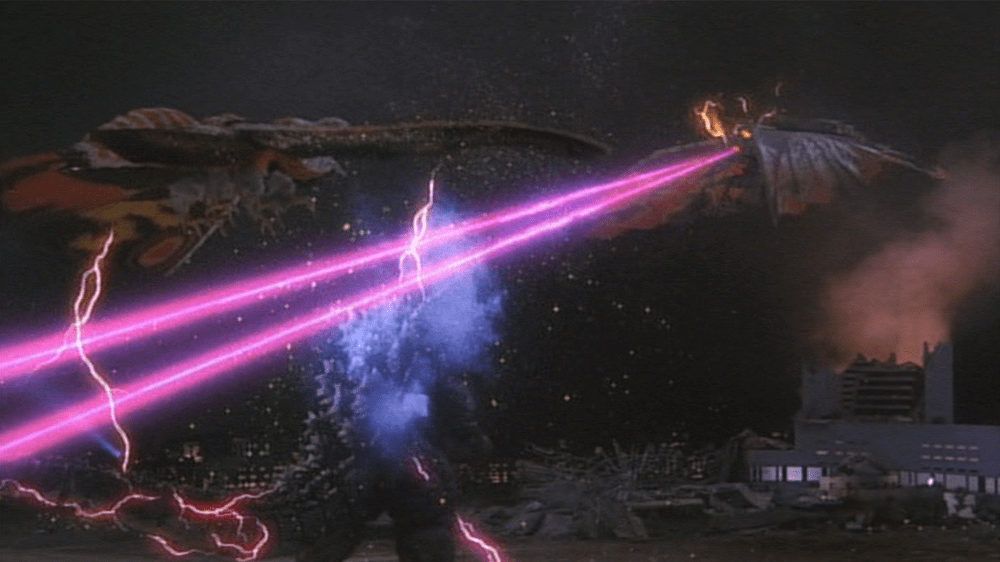
Godzilla vs. Mothra (1992)

Hot on the heels of 1991’s Godzilla vs. King Ghidorah, Toho wanted to keep the momentum and release another kaiju movie. They had finally found success, despite overseas criticism, and were ready for more. While Kazuki Ōmori wouldn’t be returning in the director’s chair, he did pen the screenplay, and continued to draw on big American action hits, this time Indiana Jones. The Last Crusade came out 3 years prior, and was massively toned down from the previous film Temple of Doom in 1984. This, incidentally, came out the same year as Joe Dante’s Gremlins (released in the middle of summer for some reason?) and the wombo-combo of two supposedly family movies with graphic violence led to the creation of the PG-13 rating. It doesn’t have much to do with the Godzilla films, which largely go unrated in America, but it’s still kinda neat. The other major influence to Godzilla vs. Mothra takes us back to 1987. Like a Godzilla film, our story starts at sea! The barge Mobro 4000, holding over three tons of garbage and tugged by the Break of Dawn set sail on March 22, 1987. The plan was to ship the garbage down to North Carolina, where it would be converted to methane as it decomposed. This was a new concept, and the shipping endeavor was partially financed by mob boss Salvatore Avellino, who would later be imprisoned for killing two garbage haulers. Like some cruel April Fool’s joke, it was denied port when it finally arrived at its destination on the 1st. Someone had spotted a bedpan in the garbage, and surmised that there would be hazardous medical waste that contaminated the entire load. As the story broke, it was framed as the fancy elite of New York City dumping their trash all of the poor working class folks of the South. The Mobro spent two months at sea being chased out of harbors by not only US Coast Guards but the navies of Mexico and Belize as well. It ended up back in New York to be incinerated, and the international incident spurred a renewed awareness of the world’s garbage disposal crisis, and an uptick in environmental activism. In the next few years, recycling programs grew and inspired the series Captain Planet and the Planeteers in 1990, which in turn inspired a foundation to get kids involved with Earth-friendly sustainability projects. So with this newfound focus on environmentalism, who better to return to the Godzilla series than the champion of Earth and the environment than Mothra herself?

Read More
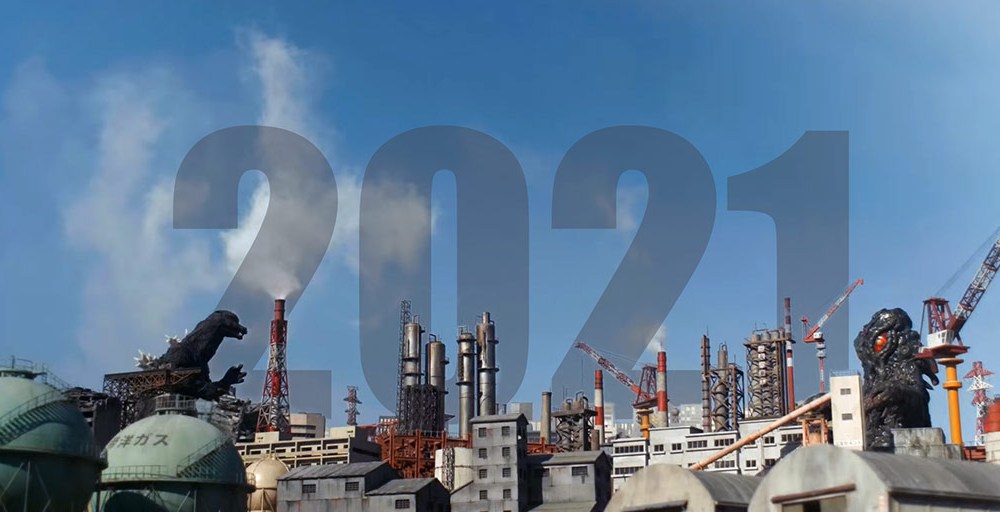
Godzilla vs. Hedorah (2021)

What’s that? Didn’t I already cover Godzilla vs. Hedorah back in July? Sure did. But this year we got quite a treat as part of Toho’s celebration of Godzilla Day on November 3rd, honoring 67 years of Godzilla, and Hedorah’s 50th anniversary. The event is essentially a merchandizing festival, but in addition some interesting hot sauces, Toho released a short film with actual suitmation featuring everyone’s favorite psychedelic induced fever dream of an anti-pollution allegory: Hedorah! Toho had put out an even shorter film last year that was kind of fun, but this one is much more involved. It’s been five years since the release of Shin Godzilla in 2016, and this a welcome little gem for fans of practical effects and suitmation. They apparently took it down from the official account, but luckily it’s been preserved by RickDaSquirrel over on Youtube, enjoy!

Read More

Godzilla vs. King Ghidorah (1991)

What does the 90s superhit American sitcom Friends have to do with Godzilla? Absolutely nothing. But in a small coincidence, our story today starts with a man by the name of Matthew Perry. No, not Chandler, but a naval officer around the year 1853. Known as the “Father of the Steam Navy,” Perry advocated for technical education of naval officers and modernization of the US Naval fleet. Prior to 1853, Japan had implemented an isolationist policy, cutting off all trade from the outside world with the exception of the Netherlands and China, and then only through the port at Nagasaki. The reason being was twofold: they saw what had happened in China with the Opium Wars, fought over trade disputes, and how much British traders brought in contraband opium and the corruption of local officials. (The first Opium War was how China lost Hong Kong to Great Britain by the way). The other was to halt the spread of Catholicism, and if you thought Catholics were pushy today, it’s nothing compared to the Manifest Destiny days. By securing the country against outside influence and controlling trade, the shogunate hoped to preserve Japanese culture and prevent any individual governor from becoming powerful enough to overthrow them. That all came to a halt when Commodore Matthew Perry sailed into what would become Tokyo Bay on his badass upgraded steam-powered battleship, insisting a letter be delivered to the leader of the country at the time, the shogun Tokugawa. After being told to piss off and head to Nagasaki, Perry shelled some buildings and the letter was delivered, outlining demands for Japan to open up trade with the US. Perry returned the following year to sign a lopsided treaty ensuring favorable terms for the US, a result of the “gunboat diplomacy.” Seeing what had happened to China, and following this aggressive strategy from the US, Japan knew it had some catching up to do or else it would be weakened or destroyed by the West. Looking to the global powers of that time, they sought to emulate their models of advancement which included imperialism fueling industrialization. Still with me? Hang in there, this pales in comparison to the plot loops of Godzilla vs. King Ghidorah.

Read More

Godzilla vs. Biollante (1989)

Long time readers will know how much I dig Norman Borlaug and genetically modified crops. His work on the Green Revolution using genetic engineering to increase crop yields has saved hundreds of millions of lives. By the 1980s, there were plenty of critics, and GMOs became, and still are, a cultural boogeyman. Critics derided it as “unnatural” and deemed it “Frankenfood.” As Borlaug once said “They’ve never experienced the physical sensation of hunger. They do their lobbying from comfortable office suites in Washington or Brussels. If they lived just one month amid the misery of the developing world, as I have for fifty years, they’d be crying out for tractors and fertilizer and irrigation canals and be outraged that fashionable elitists back home were trying to deny them these things.” He did take critics seriously though, as some claims held merit. The use of antibiotic resistant genes is used heavily in engineering, and if antibiotic resistance spreads into the biome, it could pose a major public health crisis. The fear of unexpected consequences in the field of genetics has been a common trope in science fiction from The Island of Dr. Moreau and The Boys From Brazil, to Jurassic Park and Gattaca. In updating the Godzilla series for the modern age, tapping into these fears was a logical choice, and fit the original anti-nuclear themes to a tee. While I personally feel the fears are overrated, Godzilla vs. Biollante is hands down my favorite of the series.

Read More

The Return of Godzilla (1984)

The fall of Saigon in 1975 saw an official end to the Vietnam War. Congress and the American people were fed up with the long, bloody, and futile war riddled with atrocities. The Soviet Union was in dire straits due to the inefficiency of their planned economy and heavy military spending. Leaders of both countries were ready to try something new: detente, a reduction of tensions. The US and Soviet Union had negotiated the SALT I treaty a few years prior, and were working towards SALT II, both of which would cap or limit ICBMs, launch sites, and submarine ballistic missile launchers. This period didn’t last long, however. While various treaties capped the number of missiles that each nation could hold, both sides developed new technology that could launch missiles with multiple-independently targetable re-entry vehicles (MIRVs). In essence, a single missile could carry multiple nuclear warheads, each with the ability to strike different targets. The global superpowers rekindled efforts to spread influence throughout the world, from insurgencies and counterinsurgencies in South America to the strategically located Afghanistan. After the Soviets sent troops in to Afghanistan in 1979, it killed the prospect of the US ratifying the SALT II treaty, and the US instead committed itself to supporting the “Brave Mujahideen Fighters of Afghanistan,” as dedicated in the end credits of Rambo III. We’d see how that decision would pan out 22 years later. All these tensions culminated in 1983, one of the most critical years in the re-heated Cold War. The KGB launched Operation RYAN, an intelligence gathering mission which indicated the US was planning a pre-emptive attack on the USSR. This wasn’t alleviated when the US conducted its most realistic war games to date which simulated a nuclear end scenario. The Soviets were unable to tell if it was just part of the war games, or if the games were used to disguise an actual attack. And in September, Korean Air Lines flight 007 was shot down after entering Soviet airspace. The flight happened to be carrying US Representative from Georgia, Larry McDonald. With all this, the world seemed on the eve of destruction at any moment, inspiring two 1983 classics: the feature film War Games, and made-for TV production The Day After. Now, more than ever, was the perfect time to bring back the ultimate paragon of atomic armageddon: Godzilla.

Read More

Terror of Mechagodzilla (1975)

Well, this is it, folks. End of an era. The Showa Era to be precise, and 1975’s Terror of Mechagodzilla closed the book on Godzilla for almost a decade. Unlike Destroy All Monsters, this wasn’t meant to be the end though. Producer Tomoyuki Tanaka wanted to cash in on the success of Godzilla vs Mechagodzilla with a direct sequel, which was greenlit within four months. The script comes from the rare woman screenwriter in the series, Yukiko Takayama, who won a contest. Seems like when Toho is out of ideas (or wants them on the cheap) they’ll just hold a contest, much to the chagrin of the studio’s writers and designers I imagine. This was Takayama’s first writing credit, and she would go on to write more professionally, but is the last woman screenwriter in the franchise (the only other woman, Kazue Shiba, having a co-writer credit on Son of Godzilla). 1975’s Terror of Mechagodzilla also features another feminine rarity in the franchise: some big honkin’ titties.

Read More

Godzilla vs. Mechagodzilla (1974)

It wouldn’t be until 1979 and well into the 80s when famous giant robot series like Mobile Suit Gundam and Macross would hit their stride in Japan. But even before this, the 60s and 70s were brimming with Robot Fever. From animated series like Astro-Boy and Gigantor, to live action Ultraman style shows like Johnny Sokko and His Flying Robot, and Super Robot Red Baron, robots were all the rage. Stateside we had Robby from Forbidden Planet and The Robot of Lost In Space, and across the pond there were the formidable Dalek’s of Doctor Who, all who would go on to inspire Battlestar Galactica and Star Wars in the near future. But here, on the 20th anniversary of Godzilla‘s 1954 debut, producer Tomoyuki Tanaka still had faith in the floundering Godzilla franchise, and what better way to give it a jolt than with a new giant robot of their own: Mechagodzilla!

Read More

Godzilla vs Megalon (1973)

When he wasn’t crafting monster suits for Toho’s Godzilla franchise, special effects legend Eiji Tsuburaya ran his own television production company. You may recall Tsuburaya stepping aside back in 1966’s Ebirah, Horror of the Deep, staying on only in a supervisory role for several films. What became of his pet project after passing the torch at Toho? None other than the beloved Ultraman series that spawned another suitmation genre with hundreds of series drawing from this source material. Ultraman inspired shows like Kamen Rider, and Super Sentai, best known as the production Mighty Morphin Power Rangers used footage from. Eiji Tsuburaya’s legacy is cemented in not one, but two media juggernauts that changed the history of entertainment forever. And it’s that powerhouse of creative force that lead Toho to hold a contest to design an Ultraman-esque robot that would be featured in the next Godzilla film. After a few redesigns (much to the chagrin of the kid that won the contest), this robot would become the both beloved and despised, the android with a plandroid, the polarizing pugilist, the one…and only…JET JAGUAAAAAAAR!

Read More

Godzilla vs Gigan (1972)

It’s a shame producer Tomoyuki Tanaka disliked 1971’s Godzilla vs. Hedorah so much. The following year, after recovering from illness, he set out to get the Godzilla franchise back to basics. With Japan’s film industry in steady decline, the budgetary woes continued for Toho. The rise in popularity of television and big-budget imports from Hollywood lead to the Japanese studios cutting corners all over the place. In a few years, 1975 would mark Japanese-made films falling to below 50% market share. Like All Monsters Attack, Gigan relies heavily on stock footage, though a new monster was created for this one, and man does it rock. In another cheap move, they also use recycled music from Akira Ifukube’s other movies for the score, and uh, yeah, occasionally that works out. Jun Fukuda helms the project as director, seeking to right the ship, and special effects director Teruyoshi Nakano is back for round two after his spectacular work with Hedorah. The Godzilla suit from Destroy All Monsters is used for the fourth time, and sadly this will be the final film Haruo Nakajima will play Godzilla. Nakajima has been with us from film one, bringing Godzilla’s familiar mannerisms to life, and he will be missed.

Read More

Godzilla vs Hedorah (1971)

Wow. Just… holy smokes. If you like how goofy the Showa Era Godzilla movies are, you’ll love this one. Even if you think these films are a little too cheesy, this is a must watch because it is absolutely, jaw droppingly insane. It’s one of my all time favorites, and a major reason I started this blog was to fervently share my love for Godzilla vs Hedorah with anyone who will give me the time of day. Everything about this one-off from director Yoshimitsu Banno is bonkers, including one of the most terrifying behind the scenes tales in the whole franchise. It’s so out there that producer Tomoyuki Tanaka promptly fired Banno, interrupting the planned sequel which was to take place in Africa. A mix of psychedelic surrealism, animation, environmentalism, phenomenal practical effects, and off the wall antics, enjoy it or not, you will be forever changed after watching the incomparable Godzilla vs Hedorah.

Read More