
Well, folks, we’re back! I had to take a hiatus to plan a wedding, start a new job, and help run a curling club. One season ends, just in time for another to begin: baseball! Back in 1993, the Yomiuri Giants drafted a kid right out of out of high school. How good was this kid? Well, he originally batted right-handed, but was so good that his brother insisted he start batting left-handed or he’d stop playing with him altogether. So what did this kid do? Only learn how to bat left-handed and become one of the best left-handed hitters in both Japanese and US baseball, winning the Nippon Professional Baseball MVP in 2000, and the MLB MVP of the New York Yankees World Series winning team in 2009. That kid? None other than Hideki “Godzilla” Matsui himself. 2002 saw not only Matsui signing with the Yankees, but also some major advancements in neural engineering. Scientists were able to implant electrodes into a rat’s brain, and by stimulating the left and right whisker sensors, then hitting the pleasure-reward center, were able to control the rat via remote. This allows rescuers to send rats into collapsed rubble, searching for survivors and navigating tight spaces that humans or robots can’t access. It also laid the groundwork for other technologies, restoring brain function and muscle control, inhibiting the urges of addiction, and fighting dementia. This is all well and good, but what are the ethics behind this? Short-lived lab rats are one thing, but what about larger animals? Humans? Could this be applied to create a living weapon? And what happens when the technology inevitably fails on that weapon? These are the questions that 2002’s Godzilla Against Mechagodzilla raises in the first of two entries in Toho’s “Kiryu Saga.”
Conspicuously absent from this film is any reference, textually, visually, or thematically, to the September 11th attacks on New York City the previous year. The world had changed, and America’s neverending War On Terror had begun. The massive destruction and loss of innocent life could have drawn parallels to the atomic bombings, but producer Shōgo Tomiyama and director Masaaki Tezuka didn’t want to touch that with a ten-foot pole. 2001’s GMK did well, but was too dark and somber for Toho’s line-wide marketing vision, which had Godzilla movies premiering alongside the children’s anime Hamtaro. What we get with Godzilla Against Mechagodzilla is a bog standard JSDF vs giant monster outing that doesn’t delve very deep into any particular themes. It will scratch the surface of bioengineering ethics, but pale in comparison to 1995’s anime Neon Genesis Evangelion, a source it draws heavily from. This won’t be the end of intertwining Eva and Godzilla franchises’ DNA though, so look out for more of that.
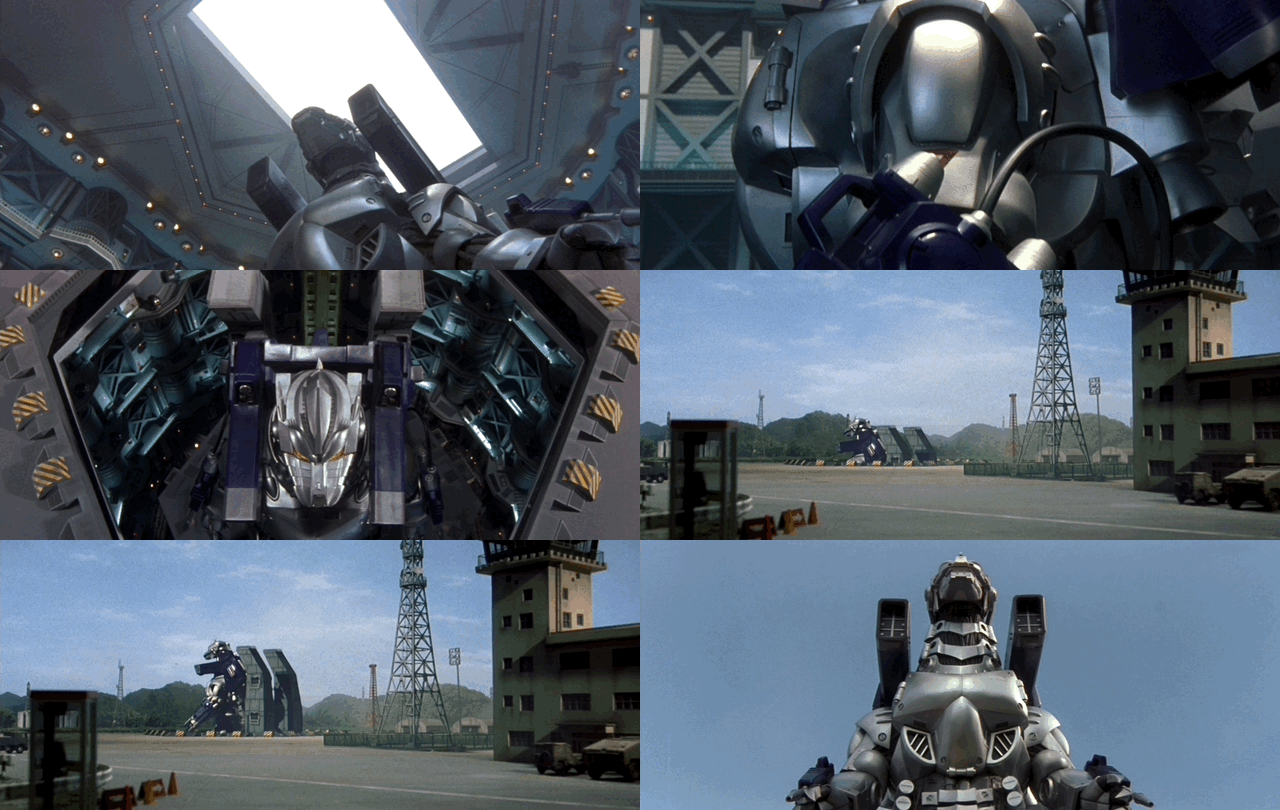
While Masaaki Tezuka was sidelined after Megaguirus, he did stay on to help out with GMK, and Tomiyama recognized the work ethic and devotion, rewarding Tezuka with another two films. Compared with director Shusuke Kaneko, Tezuka is a much more lighthearted guy. In interviews, it really shines through too, and you can tell this man absolutely loves working on Godzilla movies. Getting the promotion to director of special effects is Yuichi Kikuchi, who worked on Megaguirus and GMK as well. Kikuchi does a pretty decent job, and continues to experiment with CGI producing mixed results. The design for Kiryu is inarguably very cool. (Kiryu meaning “Mechanical Dragon,” a fitting nickname for Mechagodzilla in this series). Megaguiras composer Michiru Ōshima returns, and having lamented that her score had been drowned out by sound effects wanted to give this one a bigger, brassier sound. She went to Russia and commissioned Moscow’s International Symphony Orchestra. The size of their let Ōshima triple the amount of musicians since her previous score added the depth and gravitas she was looking for.
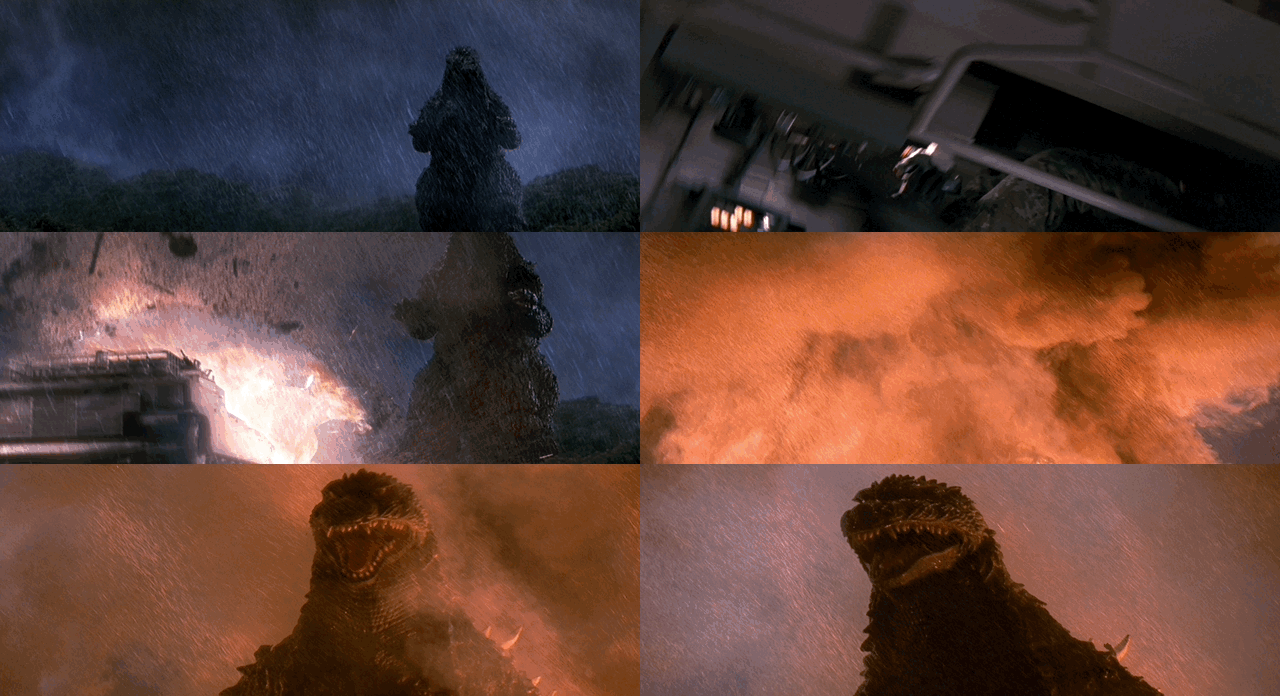
This is heard immediately as the film opens on a JSDF squadron mobilizing, an approaching storm in the background. The storm nears, and we’re treated to a brief cameo by Takehiro Murata, star of Godzilla 2000, and Godzilla vs. Mothra. There’s some other fun cameos by Godzilla suit actor Tsutomu Kitagawa, Kiryu suit actor Hirofumi Ishigaki, and a few others in here too. If you had worked on a Godzilla film in the past 5 years, and were hanging around Toho studio, you were pretty much guaranteed a bit part in this movie. Kitagawa does a solid job portraying an animalistic Godzilla, but with a slower bulkier approach than others in this era. The snout on this costume is a kind of narrow, and the eyes are more mammalian, the spines are still sharp like the Godzilla 2000 design, but smaller and more classically colored, ditching the purple. Overall, I prefer the 2000 design, but they added more animatronics to make the face more expressive.
Stop me if you’ve heard this one: an ambitious woman in the JSDF gets her commander killed while trying to repel Godzilla, and spends the rest of the movie trying to atone for it, eventually rejoining the military to pilot its latest superweapon and barely save the day. Yeah, that’s the whole plot behind Megaguiras, and it happens here too. As much as I like Yumiko Shaku, her character Lt. Akane Yashiro pales in comparison to Major Kiriko Tsujimori. Tsujimori was a character with dimensions, dealing with regret but also nursing a fiery rage that could not be quenched. Yashiro just comes down with a bad case of the sads. This film takes a sharp turn away from GMK‘s critique of militant nationalism, and a reporter asks “will our government turn and run…or will they stand and fight?” If it’s nuanced perspectives you want, look ye elsewhere.
Outgoing Prime Minister Machiko Tsuge learns of Godzilla’s attack and establishes that this is yet another direct sequel to the 1954 original. This film is unique in showcasing other kaiju that have attacked Japan since then, like Mothra and the Gargantuas from 1966’s War of the Gargantuas. In a neat little tie-in, Tsuge is played by Kumi Mizuno, famously of one my personal favorites Ebirah, Horror of the Deep, but also the aforementioned Gargantuas. Incoming Prime Minister Hayato Igarashi is played by Akira Nakao, another recent Godzilla alum. Shin Takuma plays hapless scientist Tokumitsu Yuhara, experimenting with bio-robotics. He’s commissioned to build a Mechagodzilla exoskeleton around the bones of the 1954 Godzilla. It’s a very cool concept that gets done dirty by an objectively bland cookie-cutter script that takes no risks. Prime Minister Tsuge fields some questions from reporters about concerns that Japan is arming itself with a weapon of mass destruction, but just shrugs it off. Where Megaguiras deliberately eschewed the romantic subplot, Godzilla Against Mechagodzilla sets our stoic military soldier up with the goofball nerd scientist who learns to love again after losing his wife. His kid Sara, played by Kana Onodera carries around this plant that’s implied to have her dead mother’s soul in it, which is kinda funky, but it’s just a backdrop to the rom-com subplot. He’s concerned with raising Sara, and almost turns down the Mechagodzilla project, but she mentions how baseball players take their kids on the road, which sets up this banger of a cameo by Hideki Matsui!

The first encounter with Godzilla is a short one. After firing most of its weaponry, Kiryu seems to push Godzilla on the defensive. But when Godzilla roars, it unlocks some memories in the dead bones within Kiryu, and the cyborg runs amok. It’s a pretty neat sequence, seeing the atom bomb, the oxygen destroyer, and nodding to Godzilla’s origins. Yashiro loses control, which does nothing to improve one of her squad member’s views of how she’s just a screwup. The flashing readouts, subsequent destruction, and musical score are all reminiscent of Evangelion here. It’s more than just a trope, the camera angles, the design of the rails Kiryu launches from emerging from underground, and the short battery life, they just have to let it tucker itself out. Considering Godzilla didn’t even make landfall, before slinking back to the sea, the wanton destruction Kiryu causes leaves people wondering what good this weapon is at all.

Godzilla returns at night, and the action sequences are very good. The new animatronics in the face, paired with Tsutomu Kitagawa’s suit acting make Godzilla almost sympathetic. He comes across at times as a creature in anguish, confused and out of place. Prime Minister Igarashi authorizes use of the newly repaired Kiryu, which launches to soaring hopeful music by Ōshima. Yashiro and company arrive on scene to see they’re too late to save a hospital, and will have to engage ASAP, deciding to release Kiryu mid-air. This leads to one of the best entrances to a fight in the series: Kiryu dropping down, vernier engines distorting the air in their wake, silhouetted by the moon, skidding down the road to shoulder check Godzilla right as he’s about to incinerate a nurse. (Yet another cameo: Yumiko Shaku who played our protagonist in Megaguiras). The end of this clip is a little cheesy, but the camp is what we’re here for folks. It’s a GOOD TIME in a sea of mediocrity. Yuichi Kikuchi uses CGI to augment the practical effects, and it looks good for 2002.
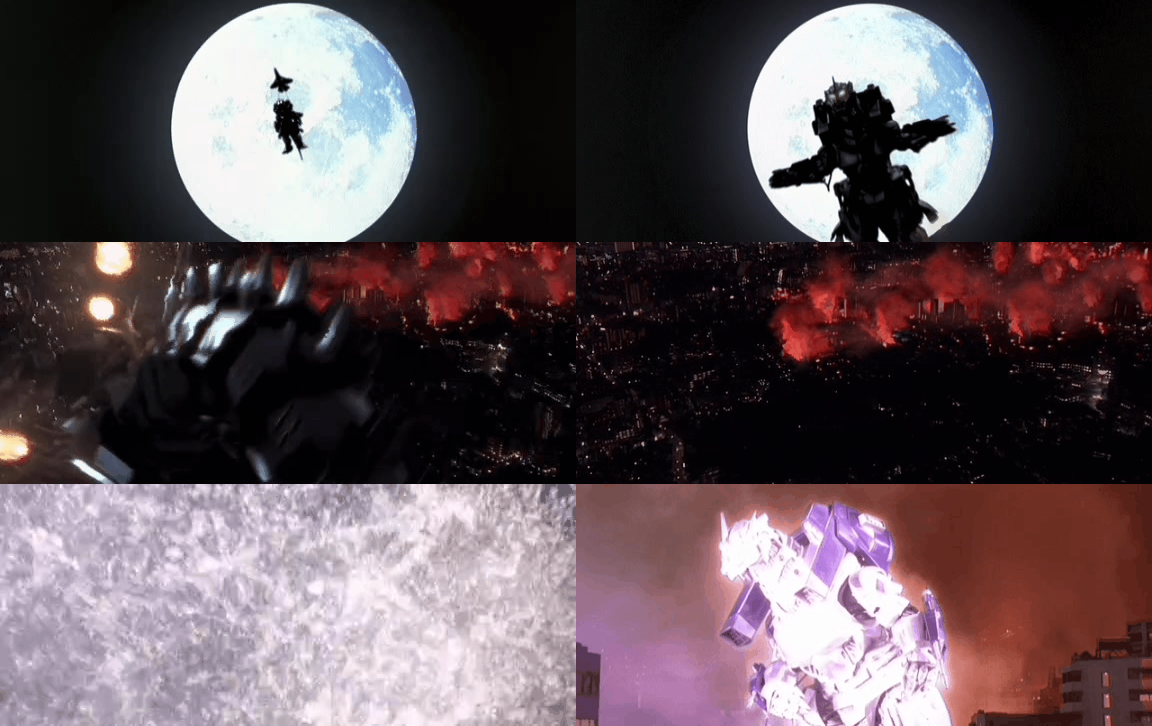
This second fight is much more eventful, complete with grappling, punching, lasers, and smashed buildings. Again, supplementing the practical effects with CGI lets Kikuchi and director Tezuka do things we haven’t been able to see before. Mechagodzilla could always fly, but now we see much more dynamic shots, with Kiryu using its jetpack to create distance for ranged attacks. It’s pretty baller. This entire sequence is legitimately incredible. Kiryu’s superweapon is the Absolute Zero system, which misfires hilariously to the chagrin of JSDF command, icing three skyscrapers. This damages the control systems, and Yashiro needs to take over manually, risking radiation exposure in the process. The city needs to cut power to give it a jumpstart and we see Matsui practicing batting in his hotel room when the lights go out, which…didn’t seem like a good idea to begin with, but I really wish he ended up smashing a lamp or window when that happened.
In the finale, Yashiro’s squad mate that had beef with her has a change of heart, and almost sacrifices himself to give her an opening to fire the Absolute Zero system again. She uses Kiryu’s jets to tackle Godzilla though, he ejects, and the system fires in Tokyo Bay. Everyone survives, and Godzilla retreats to the ocean, alive but badly injured across his chest. In the next film, you’ll see scarring where the Zero system hit him. There’s another post-credit scene with some talk about how every life is worth something, before saluting the weapon of mass destruction that hijacks the bones of a dead monster. This really didn’t need to be post-credits, but it’s starting to become a “thing” now.
I actually enjoyed this much more on the second viewing. The human story arc is rehashing everything done in Megaguirus, but not as well done. It’s a shame, because the action sequences are creative and well choreographed; it’s just such a slog to get to them. Obviously trying to emulate Evangelion, Godzilla Against Mechagodzilla aims at a sense of gravitas that is helped along by Michiru Ōshima’s music. That depth is ultimately undercut by having no real theme or consequences, and shoe-horning a rom-com into it with Shin Takuma essentially playing a Showa-era character that feels wildly out of place most of the time. It’s strange that Tomiyama wanted a more lighthearted film, and they went with this. Perhaps it needed to differentiate itself from Megaguirus, but the mixed tones just don’t work well. That Kiryu design is something to behold though. Stay tuned for more mecha-shennanigans as the Kiryu Saga wraps up its second even worse half in Godzilla: Tokyo S.O.S.!
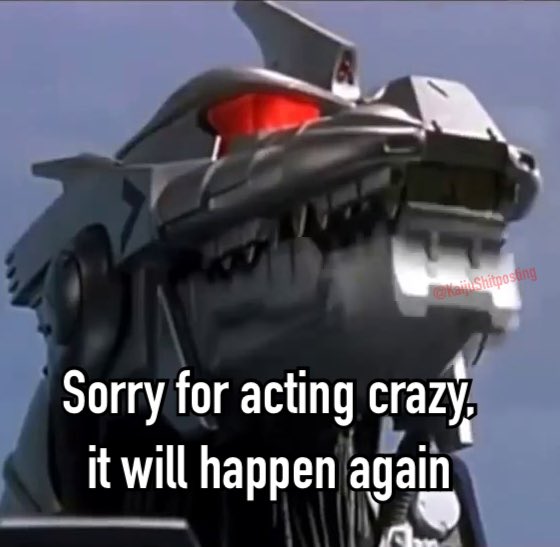
 Godzilla Vs...!