
How crazy is it that in 2017, a former special agent and Pentagon employee leaked evidence that the US Military had on UFOs and the investigations into them, to very little fanfare? It barely made headlines, and was just churned through the 24 hour news cycle and forgotten, pending further investigation. Where did our fascinations with UFOs go? You can find alien trends in popular culture at various points, from War of the Worlds (the book, 1898) to War of the Worlds (the radio broadcast, 1938) to War of the Worlds (the movies, 1953, 2005). For anyone older than 25, UFOs were a major part of life, permeating our entertainment in nearly every genre, and even if you didn’t believe in little green men from far off galaxies barnstorming the skies and probing rednecks, you were guaranteed to at least know someone who did. Part of the reason this major story didn’t make many waves was because of the outrage overload from 2016-2020. It’s easy to get lost in a sea of news when twice a day you had a story coming out of the White House that was the most ludicrous thing you’d ever heard. But another part, especially in an age of people wary of fake news, is there really isn’t any evidence to say “Yes, those were aliens.” The Pentagon report doesn’t rule out the possibility, but stresses that there is no solid evidence for extraterrestrial technology. It really takes the wind out of the sails, but UFOs are, by very definition, “unidentified.” Another reason I’d posit, is that UFOs in pop culture tend to represent the unknown and the other. With the advent of the internet, we became a much more connected world. Many stopped seeing others from foreign nations and far-off lands as the “other” or “them;” strange, curious beings beyond reach or understanding. Especially if you lived in a small town, and never travelled abroad, you may never have met or conversed with someone from China, Ghana, Austraila, or Peru. It could seem like various cultures were far more different than they were similar. The internet changed all that. You could connect with anyone, and suddenly had access to local news from around the country, or the world, complete with updates and retractions, and the ability to cross check references. The 90s seemed to be the last hurrah of the weird, cryptid, UFO, crystal energy, astrology, ghost, possession, spontaneous combustion, type of fun conspiratorial fascination. Which is not to say conspiracy theories disappeared, just that they’re a lot more sad, disappointing, (relatively) grounded, and politically motivated. Image and video resolutions also became much clearer, making it harder to fake “evidence,” and you had more people collaborating digitally to find the truth and debunk hoaxes. It was much easier to believe there were more things in heaven and earth before we started documenting every little occurrence for all to see on the internet. But what a time to be alive! 1996 gave us both Independence Day, and Mars Attacks! In 1997, we got the adaptation of Carl Sagan’s Contact with Jodie Foster, alongside Will Smith and Tommy Lee Jones’ unforgettable Men In Black. Not to mention David Duchovny and Gillian Anderson’s seminal run of the X-Files. It was a decade of change, the dawn of the global information age, those who grew up around that time experienced the transition from cassette tapes to CDs to mP3s in a whirlwind of advancement, with film evolving on a similar track. This is the environment in the year 1999 with the Y2K bug looming on the horizon, eve of a new millennium, that Godzilla 2000 sprang to life.
After the massive disappointment of Emmerich’s American Godzilla, Toho didn’t want to wait to revive the King. They didn’t have any plans to create more Godzilla movies until 2005, but Emmerich and Devlin screwed the pooch so hard on that project that both fans and the studio felt they needed to turn things around and do it right immediately. And that’s exactly what Godzilla 2000: Millennium is, a direct response to everything wrong with that other film. With Tomoyuki Tanaka’s passing in 1997, co-producer for most of the Heisei era Shōgo Tomiyama took the reins of the Godzilla franchise. He felt it was important to get a variety of perspectives on what makes Godzilla great and unique, so he hired two screenwriters Hiroshi Kashiwabara (of Godzilla vs Spacegodzilla) and Wataru Mimura (Godzilla vs Mechagodzilla II) alongside director Takao Okawara of several Heisei films. Kenji Suzuki who assisted in special effects for other Godzilla movies was head honcho for this production. Regarding the design, Okawara felt that Godzilla’s size had gotten too large, and wanted to bring him down closer to the people. The attacks have more of an impact when you can see the creature seeing you, rather than passing by and ignoring you like insects. It depends on what the director is going for, but I personally like this decision in contrast with an impossibly massive creature being more akin to a natural disaster than a monster. He also wanted a fresh new depiction without completely giving up on core concepts like the Emmerich movie did. This suit is loosely based on the King Kong vs. Godzilla suit, unique in the entire series for being much more angular and lizard-like with less boxy and mammalian facial features than the Heisei era suits. The dorsal fins are large and jagged, with a purplish hue, and the scales are actually officially green as opposed to the charcoal grey of previous suits. His atomic breath is orange, which is merely ok, but overall this new look rules. You can imagine my excitement on seeing the trailer, it was immediately clear that Toho knew what they were doing and this was going to kick ass. Unfortunately (or fortunately for some), Rob Zombie’s “Superbeast” featured in the trailer was not in the movie. It may not have a classic Godzilla feel, but it completely encapsulated the cool and extreme late 90s, and was leaps and bounds better than Puff Daddy’s “Come With Me” from the American Godzilla.
This new Godzilla is being tracked by Yuji Shinoda played by Takehiro Murata, the corporate stooge from Godzilla vs. Mothra, and his daughter Io played by Mayu Suzuki. They’re essentially tornado chasers, called the Godzilla Protection Network, with equipment mounted to their van which serves as a mobile tracking station a la 1996’s Twister. This is SUCH a cool concept, made even better by the fact that they’re a father/daughter team and the 12 year old daughter handles the entire business side of the operation while her dad just does the science. Io is pretty competent in the scientific area too, explaining how the equipment works to reporter Yuki Ichinose played by Naomi Nishida, who has tagged along to grab some photos of Godzilla. They pick up a signal, and our introduction to Godzilla is equal parts intimidating and hilarious. A lighthouse keeper nearby sees a boat slowly going by, in the air, right outside the window, a place where boats should not be. You guessed it: it’s in Godzilla’s mouth!
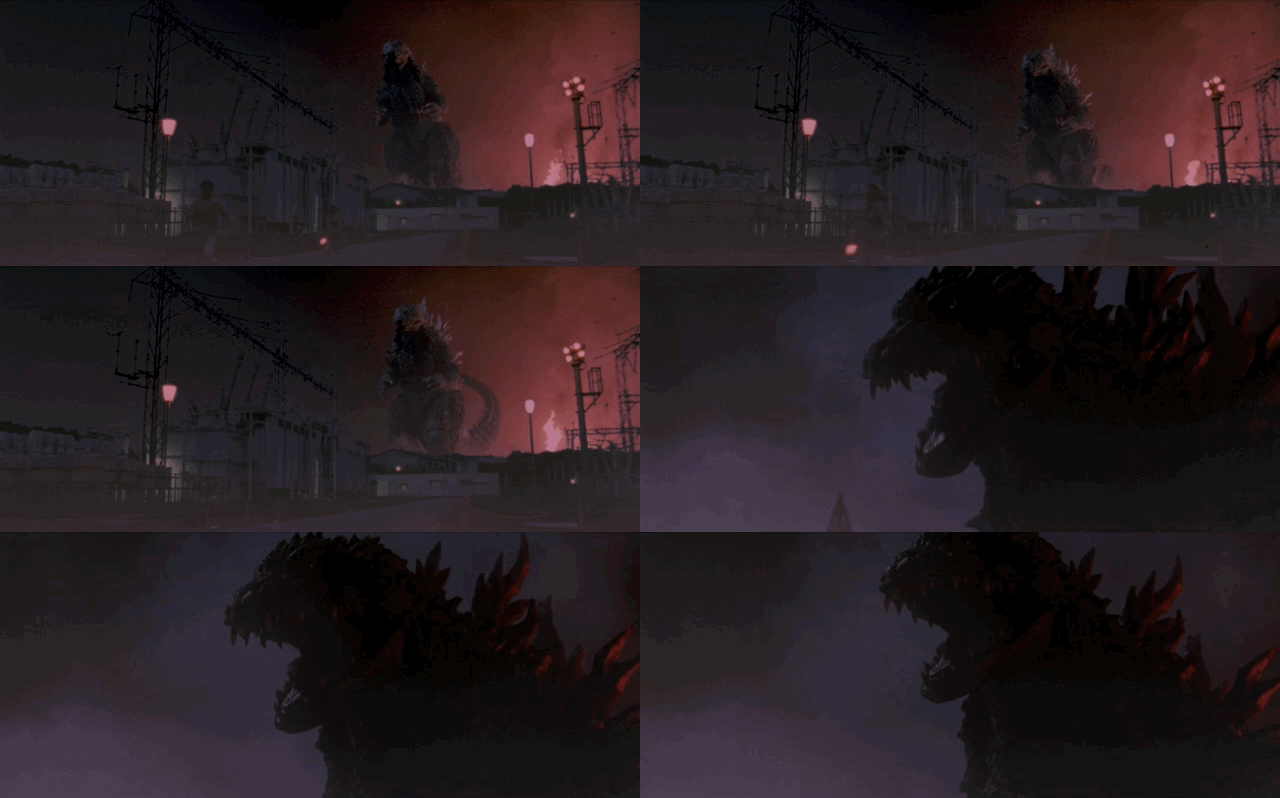
There’s another great moment as the GPN crew drives through a tunnel only to find themselves with the road collapsed in front of them, face to face with Godzilla. In a panic, Yuki flashes some pictures, which draws Godzilla’s attention and they have to book it in reverse back through the tunnel. He proceeds to attack an electrical plant at Nemuro, and new suit actor Tsutomu Kitagawa fits the role like a glove. The rest of the crew do a great job puppeteering the tail lashing about too. The color palette in this movie uses a lot of tertiary purples and oranges, giving this entry a unique style.
When Yuki gets back to the office, her boss notes that the film is ruined by Godzilla’s radiation; she got a little too close, and has to go back out and try again. I absolutely love Yuki’s attitude here, she’s not shy about hating this assignment, she’s plain miserable the whole time and calls it a “pain in the ass.” Like the Godzilla beat is something they assign to new reporters before bumping them up to something more respectable. Meanwhile, our antagonist Mitsuo Katagiri played by Hiroshi Abe is working with Crisis Control Intelligence, an agency that’s discovered a 65 million year old meteor at the bottom of the ocean that could be used as an energy source. They’re caught off guard when it starts moving on its own during the recovery operation. Abe plays Katagiri as an intense, greedy, power-hungry suit and just nails it. His over the top performance makes him delightfully hateable. He is competent though, and when Godzilla resurfaces, he calls for the emergency shutdown and evacuation of a nearby power plant. This frantic scrambling drives home the dangers of nuclear technology, and reinforces Godzilla’s main themes in a way Emmerich completely failed to do. Katagiri meets up with Shinoda, and we see the two have a shared past, with Mitsuo going the corporate route and wanting to kill Godzilla, while Yuji wanted to remain independent and study him.

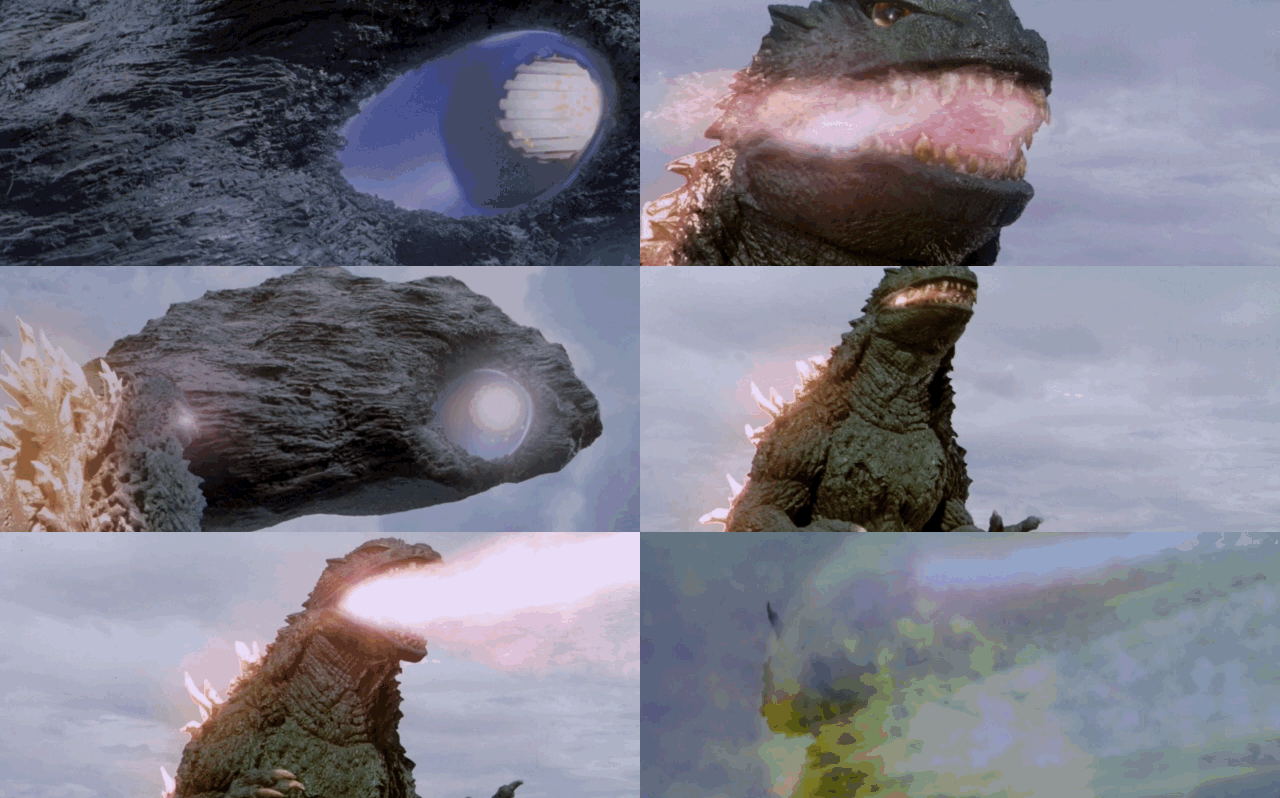
Back in the ocean, the oblong meteor rises up vertically freaking everyone out. I’m not saying that 2016’s Arrival was directly influenced by Godzilla 2000, but I’m also not not saying that either… The meteor then takes off and starts flying towards Godzilla, emitting some pulsing theremin sounds so emblematic of old 50s flying saucers. It scans Godzilla’s cells before firing a laser blasting him through a building. Oh man, you done goofed, UFO. Godzilla’s plates charge up orange before firing his own atomic breath, but I’m not sold on it. We saw a deeper orange-red in Godzilla vs Destoroyah, but it complemented the burning design of his body literally in meltdown. It fits the films color palette though, and it’s still good to see the filmmakers try something new without distancing the design from the past too much either.
Once the UFO recovers, it burns off the outer casing of rock to reveal a sleek chrome hull underneath, and from here on out, will be computer animated. It’s not great, but the reflective CGI appearance gives it an other-worldly feel during the times it doesn’t look completely fake. Kenji Suzuki also uses a lot more composite shots, reducing the need to build miniature cities. The preference of green screens over blue in chroma keying had become more popular due to retaining more detail in lossy compression algorithms, and Suzuki relied on this heavily. Though Suzuki had worked under Koichi Kawakita for many years, his team’s compositing work just doesn’t hold up as well in a lot of shots. This entry has some good things going for it, but consistency in quality is not one of them.
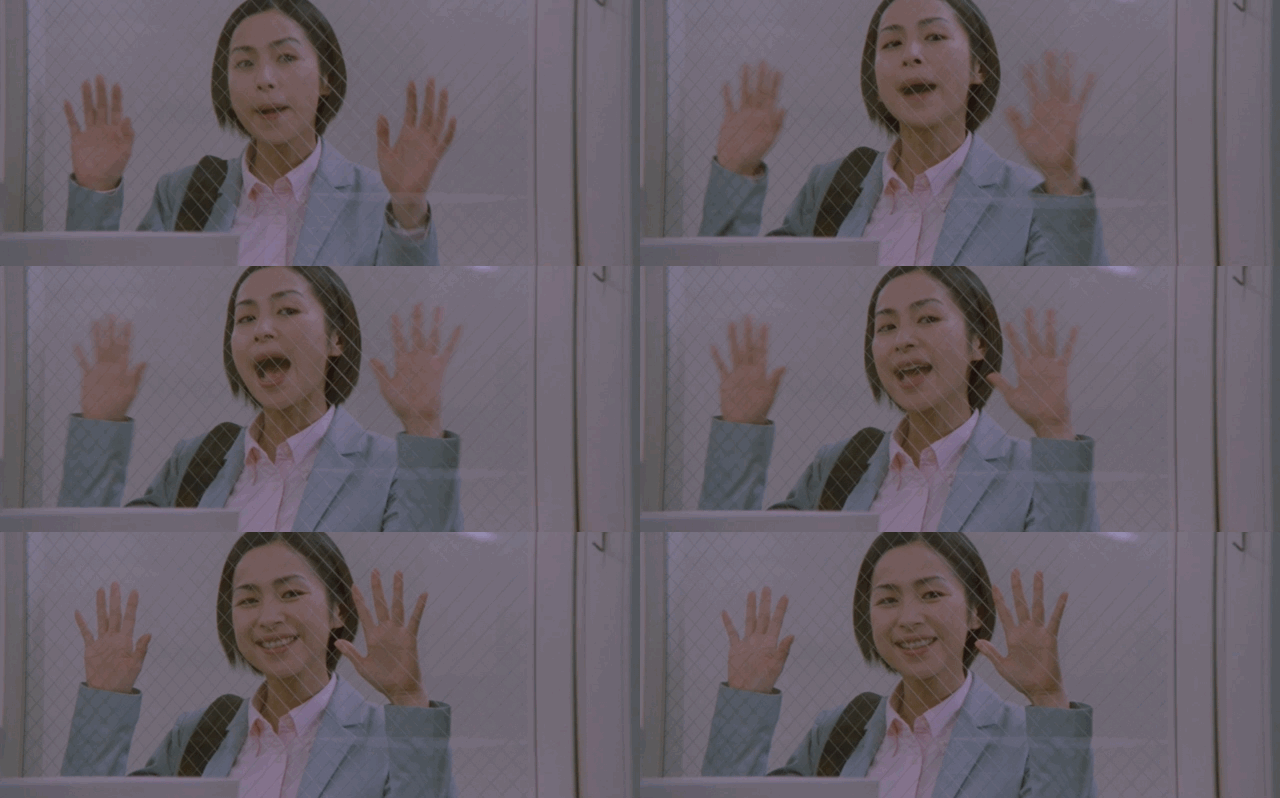
In the buildup to the final showdown, Yuki starts to warm up to her companions in the GPN, and there’s a weird but tender moment as she’s waving goodbye to Yuji through a window…with both hands. She also starts focusing on the alien business more and Io’s like “why are you covering that dumb UFO shit? We’re a GODZILLA fanclub…” Which is incredible, but I don’t think this makes it into the American translation. Godzilla fights the UFO in a city, and there are some great model shots that get destroyed, but this is where the movie gets really weird. This alien thing has been gathering data, and seems especially interested in Godzilla, and is able to take a physical form, coalescing into a bizarre War of the Worlds looking jellyfish creature. This sequence is ridiculous in every way; the effects were not good at the time, and aged even worse. The music keeps ramping up with higher and higher pitch for almost a full minute as this happens, a hilarious low point in the movie. But we love this kinda cheese don’t we folks? It does end up solidifying into a more Toho-esque monster called Orga, who’s able to control the space ship remotely, so Godzilla’s essentially fighting a two-piece monster! It makes for an amazing battle. Orga at one point jumps away like “Hey! Look over here!” before whacking Godzilla with the UFO from the side.
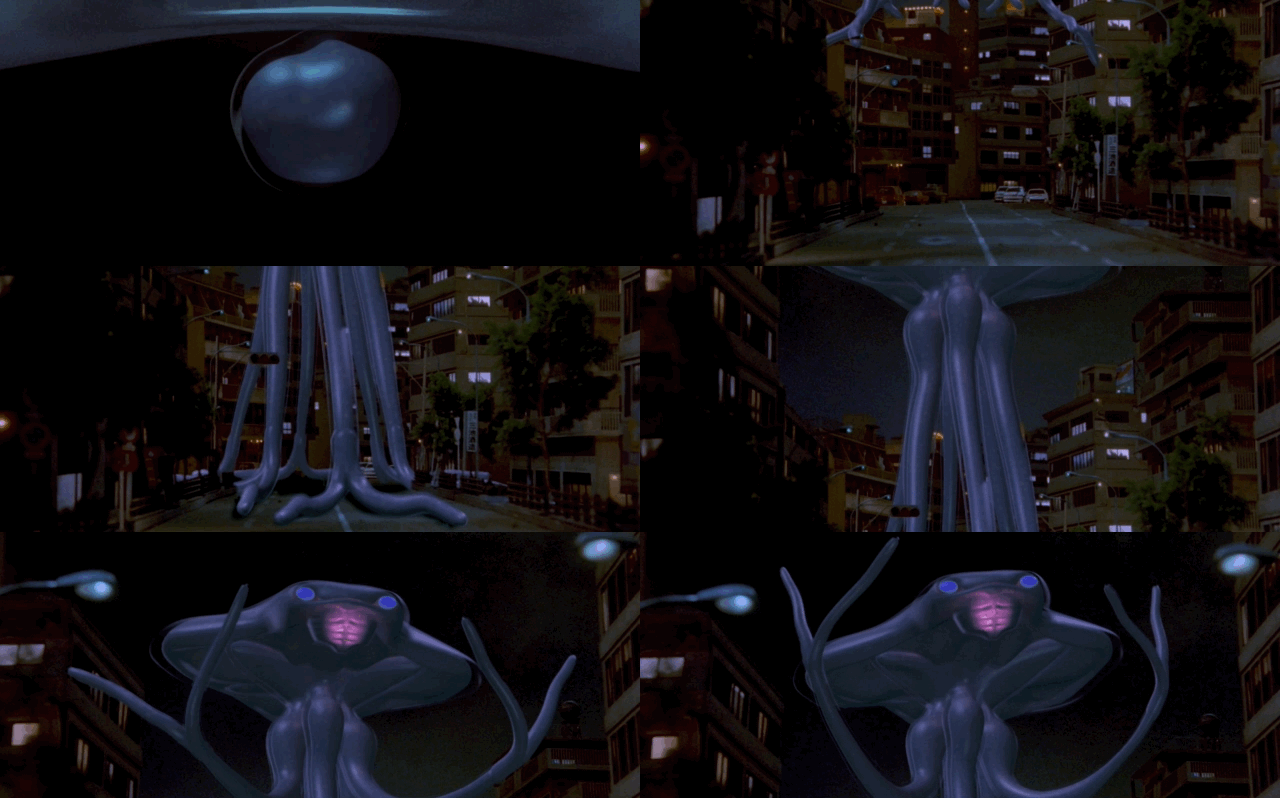
There’s a plot thread about how Godzilla’s cells regenerate quickly, and the monster having absorbed his DNA can do the same. Over the course of the fight it tries to absorb more Godzilla cells and become more like him, some shots using CGI to augment the suit effects and it actually works pretty well. When it grows dorsal plates, the visuals are particularly impressive. But Orga makes the Biollante mistake of trying to eat Godzilla, who’s like “uh, WHAT?” and it is so incredibly funny to see a monster do a double take.

This predictably doesn’t go well for Orga who gets obliterated by Godzilla’s pulse attack. Our main characters have been watching from a nearby rooftop, and they all evacuate as he approaches, with the exception of Katagiri. He just lights a cigarette, standing in awe of the creature he’s vowed to kill, who just saved Earth from an extraterrestrial threat. By way of atoning for his attempts to hunt Godzilla, he stays put and has a near-religious experience as he meets his end. Ever excessive in his performance, he stares up shouting “GODZILLAAAAAAAAAAAAAAA!!!” until a clawed hand comes crashing down around him. With the city an empty wreck, Godzilla’s roars echo through the desolation. Yuki asks why Godzilla protects us despite humanity trying to kill him since creating him, and Shinoda responds that maybe it’s because there’s a little Godzilla in all of us. It really warms the heart to think that deep down, everyone has little uncontrollable radioactive force of destruction to get them through the day. Keep that in mind next time you feel insecure.

As opposed to most films that see Godzilla worn out and peacefully returning to the sea, the final shot shows him laying waste to what’s left of the city, truly an unstoppable god of a monster. The response to Emmerich is loud and clear: this is how it’s done. Godzilla 2000 taps into all the things that makes the series great in a way that doesn’t feel like it’s checking boxes off a list. It has a sincerity that embraces the goofy nature of it all, while trying to maintain an aura of unspeakable violence. It’s a movie that gives the people what they want, with plenty of practical effects that showcase how much visual artists and suit actors love what they do. It hearkens back to the old midcentury science fiction tropes and places proper fear and respect around nuclear energy. The characters are fun and personable in a familiar way, but the movie takes some risks too. All in all, this was a hell of a return to form for the franchise, and highly recommended. Until next time, readers!
 Godzilla Vs...!