
Long before Oppenheimer became Death, the destroyer of worlds, an incredible woman made groundbreaking discoveries in radiation in the late 1800s. Marie Curie, born Marie Skłodowska in Poland, was disallowed from enrolling in the University of Warsaw because she was a woman, so instead went to a secret underground school called the Flying University, established to offer education to young Poles and say “F U” to the Prussian and Russian Empires that split control of the country. Pursuing more opportunities and formal education, Marie moved to France and enrolled in the University of Paris where she met her future husband Pierre Curie. The two built on Henri Becquerel’s research that Uranium was able to effect photographic film just by being near it, and the three collectively won the 1903 Nobel Prize in Physics after Pierre insisted they share credit with Marie after the Nobel committee left her out of the nomination. The two scienced the hell out of the 1900s and had a brilliant daughter Irène who collaborated with them. Meeting and marrying one of Marie’s lab assistants, Jean Frédéric Joliot, they both changed their surnames to Joliot-Curie and continued to study nuclear physics. Frédéric is notable for not only pioneering work on nuclear chain reactions, but also resisting the German invasion during World War II. The dude smuggled his research out of the country to keep it from falling into Nazi hands, gave up nothing under intense interrogation, joined the Communist Party and local resistance, and fought to kick the Nazis out of France. Where the Manhattan Project was focused on building a nuclear bomb, Joliot-Curie’s research was focused on developing a source of energy to fuel the war efforts. To this end, post-war Joliet-Curie was appointed the first commissioner of atomic energy, but was dismissed due to France’s growing anti-communist leanings and Frédéric’s vow to never work on building atomic weapons. His successor was much more open to the idea of working with the military, and by the mid 60s they started testing nuclear weapons in French Polynesia. Despite assurances to native people in nearby islands that France would conduct the tests responsibly, residents of Tahiti were still blasted with 500 times the allowed radiation dosage and suffered a wave of widespread cancer. The government continued to deny that testing caused any negative effects well into the mid 90s when testing resumed under President Jacques Chirac, which is probably why 1998’s box office bomb points fingers at France while completely ignoring the United States’ own sordid nuclear track record. That’s right, for this entry I re-watched Roland Emmerich’s Godzilla so you don’t have to.
You may remember that TriStar had been trying to pull off a Godzilla movie for a while now. The project had been stuck in development hell, leaving Toho to produce two more films after 1993’s Godzilla vs Mechagodzilla II. TriStar had originally approached Ted Elliot and Terry Rossio for a script. They had worked together on Little Monsters, Alladdin, and The Puppet Masters, and the core concept of their movie sounds like it would have rocked. Envisioning a Moby Dick type story, the protagonist would have been a woman scientist who lost her husband in a Godzilla attack, and spent the movie obsessively seeking revenge in the wake of her grief. What we got though…was not that. With the success of Independence Day, and known for doing sci-fi on a budget, director Roland Emmerich and producer/screenwriter Dean Devlin hopped on to the project, but only on the condition that they could do it their own way. They threw out the script, came up with a decidedly non-Godzilla looking design, and were met with dead silence when presenting the project to Toho for approval. But because Toho knew they could cash in big and Emmerich had taken a “my way or the highway” approach, they eventually gave in.
Creature designer Patrick Tatopolous created the monster to look like an iguana with a massive underbite and protruding chin, taking inspiration from the tiger in The Jungle Book, Shere Khan. When images were leaked before the movie came out, I was crushingly disappointed. TriStar even went to great lengths to keep the design secret until the movie came out (thinking the surprise was going to be cool), and didn’t allow merchandise to be released until the movie premiered. Part of the reason Toho had ventured down this path of leasing the Godzilla license to America was because most of their Godzilla profits had come from merchandise sales, and those were strong even when there wasn’t a movie coming out. They could coast on clout alone, and rake in some extra cash without having to actually make the next movie. In America though, because of this secrecy, a lot of companies were left holding a bunch of worthless product as nobody wanted to buy the Godzilla toy and T-shirt lines after they saw how god-awful the film was.
The film doesn’t actually start out too bad, despite its refocus on France instead of America as the cause of Godzilla’s mutation. We see some footage of atomic bomb testing, and some shots of iguanas nesting and swimming around. Then, in classic fashion, a Japanese fishing boat is torn apart by massive claws! It gets you hopeful as this is such a strong part of the franchise’s DNA. In retrospect, the caricature-level portrayal of the Japanese is pretty outrageous: you’ve got a guy watching a Sumo match and eating noodles with other workers gut fish belowdecks. These are all the things Japanese people do all the time right? One of the guys survives though, and does give us an amazing performance as Jean Reno questions him about the creature, only able to utter a single word on repeat through his delirium: “Gojira…Gojira…” This is yukked up for a gag later in the film as an obnoxious reporter (played by great Harry Shearer) Americanizes it saying “Godzilla” as his secretary who is aspiring to be a reporter herself (Maria Pitillo) yells back “It’s GOJIRA you idiot!”

Our main character is Nick Tatopolous, partially named after the film’s creature designer, played by Matthew Broderick. Some people don’t like his performance in this, but I think it’s perfectly fine for what he was given. It wasn’t him that ruined the movie, you just can’t do much with a script that bad. He’s studying the effects of radiation on worms in Chernobyl when some military brass fly in to reassign him. Shrouded in secrecy, he gets to a site where Godzilla has attacked another ship without knowing what he’s getting into until he realizes he’s standing inside Godzilla’s footprint. It’s a solid moment, and one of our last for the whole film. Meanwhile in New York, Nick’s love interest Audrey Timmonds (Pitillo) is being sexually harassed by her boss Harry Shearer. Shearer does a great job playing a scumbag throughout, but Maria Pitillo wasn’t able to add much of anything to an already terrible production and the movie effectively ended her chances in Hollywood. Emmerich seems like he’s never actually been to New York, and only ever seen it depicted in TV and movies because everything about it is very “HEY I’m walkin here! Bada bing bada boom! Fuggedaboudit!” An establishing shot literally prints out “THE CITY THAT NEVER SLEEPS” like he’s purposefully trying to get you to squirm in your seat.

It’s dead obvious at every turn that this was a self-indulgent circle jerk, and that Roland Emmerich had no interest in Godzilla and just wanted to make a big disaster movie. It’s full of cutesy barely subtle easter eggs like the asshole mayor being named “Ebert” with an assistant named “Gene.” One scene has Barney playing in an office, yes the children’s show for children who barely know how to talk is playing in an office for grown ups because dinosaur. In another, the camera is straight up focused an action figure of one of the aliens from Emmerich’s Independence Day, not even in the background. It’s like he just wanted to scream “Hey! Here are the jokes, people!”
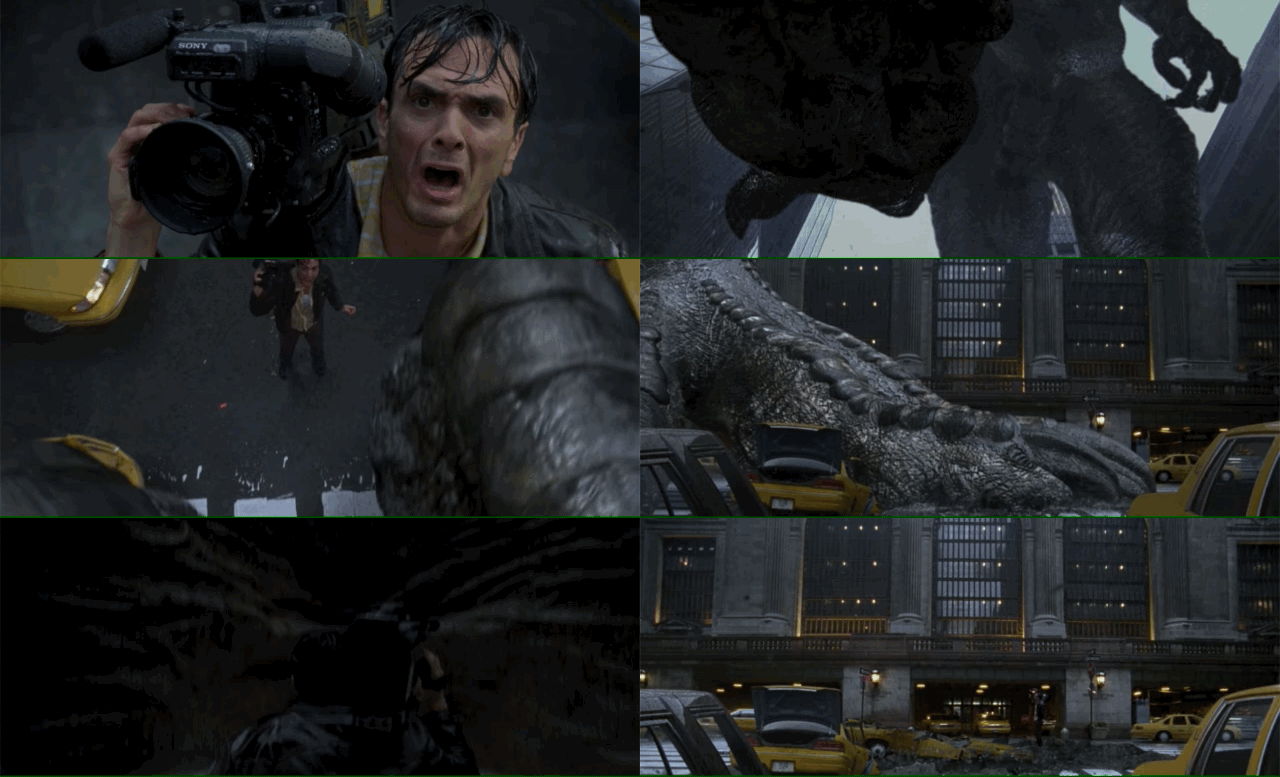
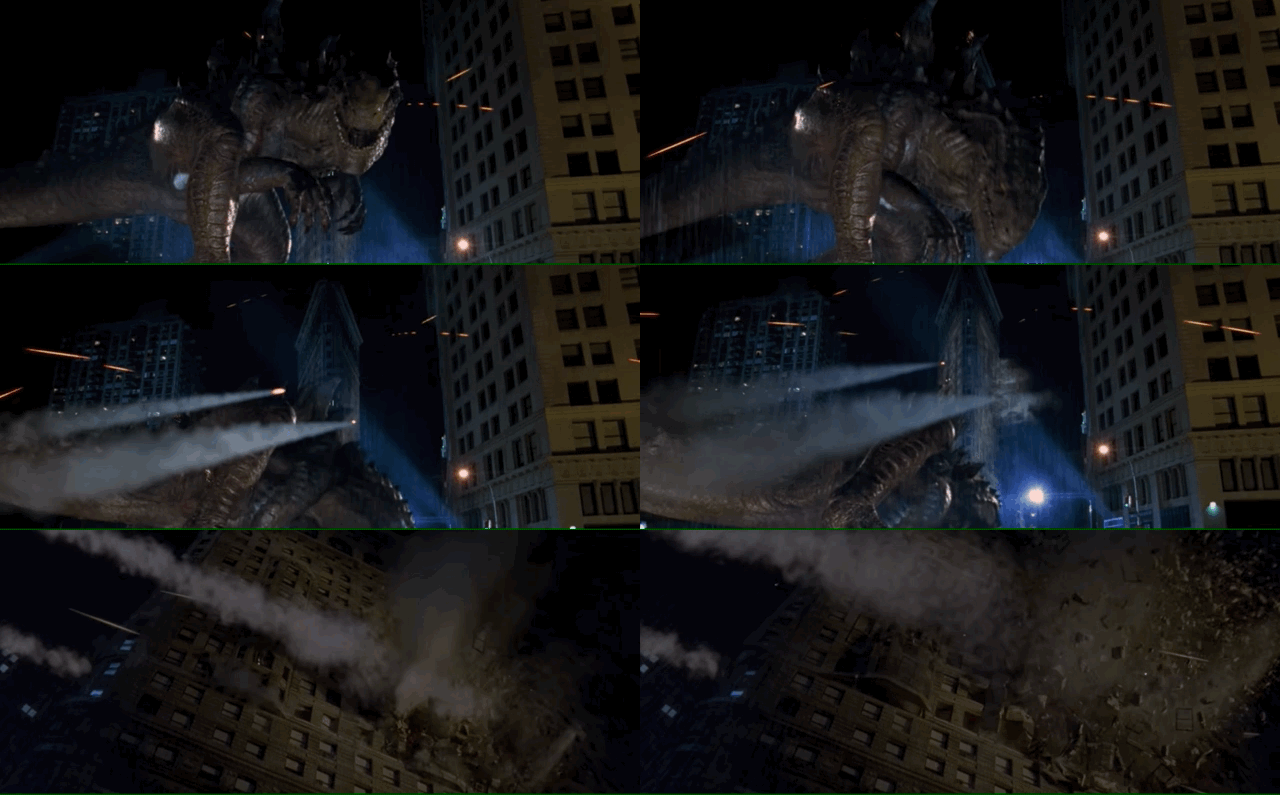
When Godzilla arrives in New York, there is a great shot of Hank Azaria’s character “Animal” running out to get footage on camera and just barely avoiding getting stomped to death. The city is evacuated, and the military loses Godzilla. Like how though. Apparently he can dig, and burrows underground and they have to lure him out with a giant pile of fish. When the military attacks, they somehow manage to miss him completely and he keeps dodging bullets and missiles, providing Emmerich an excuse to destroy landmarks like the Chrysler and Flatiron buildings. Instead of atomic breath, this Godzilla just has apparently highly flammable fish breath too. He’s just a big animal, and aside from stomping around and damaging buildings, there’s no bigger threat. Nobody is affected by his radiation, there’s no keloid scarring, no radioactive blasts. He’s not nigh-invlunerable, and dexterously avoids missiles instead of tanking the damage. This thing just straight up lacks the menacing weight and character that Godzilla should have.
After Godzilla slips away, we’re treated with probably the most bizarre scene in the movie. Out of nowhere, Nick decides to buy a bunch of pregnancy tests. Like human pregnancy tests. He says they’ll work for Godzilla, but I don’t know about that. If you’re a biologist and this is actually plausible, let me know! Audrey sees him in the bodega, and they go back to his mobile lab to see if Godzilla’s pregnant. Again, this seems out of nowhere, but he does later mention that animals will travel great distances to nest, and theorizes that’s what Godzilla’s doing in New York. It seems like a stretch of logic that was shoehorned in for the express purpose of having the line “he’s…pregnant?” like it was a surprise to him. If you didn’t suspect he was a she, why did you buy all those pregnancy tests?!? So Nick Tatopolous not only has blood samples from some of the injuries Godzilla sustained earlier, but somehow also has a huge beaker full of Godzilla pee as well. Not only that, and this is the wild part, but he offers to make Audrey some tea and makes it in the same exact size and shape beaker that the pee is stored in! DO NOT mix up those containers!
Audrey, wanting to make it big as a reporter, steals a tape that Nick had at the lab, and when the military sees the story air (stolen by Harry Shearer’s character), they fire him for leaking the info. Nick is then approached by Jean Reno’s Philippe Roaché, a French black ops agent trying to cover up the fact that his country’s nuclear testing created this beast. They’re eventually able to find the nest, alert the military, and narrowly escape before Madison Square Garden is demolished in an air strike. The baby Godzillas that hatch just show how much Emmerich really liked the Velociraptors in Jurassic Park and wanted to put some in his movie too. Finally, after over two hours, Godzilla is shot down and the movie ends but zooms in on a remaining egg that hatches, very optimistically implying a sequel.
If you’re wondering if there’s any reason to revisit this travesty, I can tell you there isn’t. There’s some decent moments, but this movie is way too long with way to much garbage to justify it. The juice isn’t worth the squeeze, folks. For a disaster film, at no point did it take itself seriously. And for someone who didn’t like how corny the (Showa era) source material is, Roland Emmerich sure did throw in a lot of cheesy jokes and gags. The CGI is not great, and using a few shots of practical effects just makes it stand out worse. This wouldn’t be the end of things for American Godzilla though. An animated series was produced, and was also not great, though it did have more monsters. And this version would show up later in Toho’s Godzilla: Final Wars as simply “Zilla” because there was nothing God-like about her. It’s a ton of fun when we get to that. At least we all got to learn a little bit about France’s nuclear history, Marie Curie, and her family along the way. One last fun tidbit: if you want to read Curie’s manuscripts, you have to sign a waiver and put on protective gear because it’s still radioactive. Unfortunately working with Polonium and Radium so much is what killed her at a relatively early age, and why they lined her coffin with lead upon burial. Next up, the dawn of a new era!
 Godzilla Vs...!