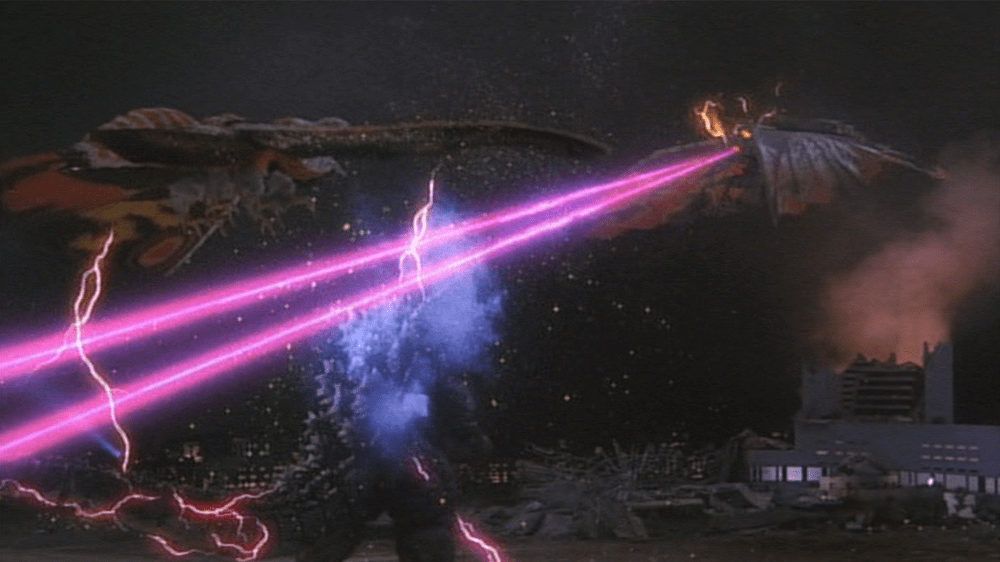
Godzilla vs. Mothra (1992)
Hot on the heels of 1991’s Godzilla vs. King Ghidorah, Toho wanted to keep the momentum and release another kaiju movie. They had finally found success, despite overseas criticism, and were ready for more. While Kazuki Ōmori wouldn’t be returning in the director’s chair, he did pen the screenplay, and continued to draw on big American action hits, this time Indiana Jones. The Last Crusade came out 3 years prior, and was massively toned down from the previous film Temple of Doom in 1984. This, incidentally, came out the same year as Joe Dante’s Gremlins (released in the middle of summer for some reason?) and the wombo-combo of two supposedly family movies with graphic violence led to the creation of the PG-13 rating. It doesn’t have much to do with the Godzilla films, which largely go unrated in America, but it’s still kinda neat. The other major influence to Godzilla vs. Mothra takes us back to 1987. Like a Godzilla film, our story starts at sea! The barge Mobro 4000, holding over three tons of garbage and tugged by the Break of Dawn set sail on March 22, 1987. The plan was to ship the garbage down to North Carolina, where it would be converted to methane as it decomposed. This was a new concept, and the shipping endeavor was partially financed by mob boss Salvatore Avellino, who would later be imprisoned for killing two garbage haulers. Like some cruel April Fool’s joke, it was denied port when it finally arrived at its destination on the 1st. Someone had spotted a bedpan in the garbage, and surmised that there would be hazardous medical waste that contaminated the entire load. As the story broke, it was framed as the fancy elite of New York City dumping their trash all of the poor working class folks of the South. The Mobro spent two months at sea being chased out of harbors by not only US Coast Guards but the navies of Mexico and Belize as well. It ended up back in New York to be incinerated, and the international incident spurred a renewed awareness of the world’s garbage disposal crisis, and an uptick in environmental activism. In the next few years, recycling programs grew and inspired the series Captain Planet and the Planeteers in 1990, which in turn inspired a foundation to get kids involved with Earth-friendly sustainability projects. So with this newfound focus on environmentalism, who better to return to the Godzilla series than the champion of Earth and the environment than Mothra herself?
Read More Godzilla Vs...!