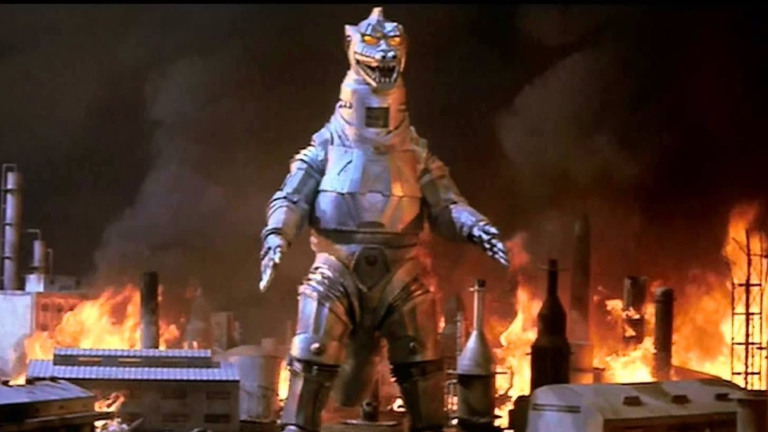
It wouldn’t be until 1979 and well into the 80s when famous giant robot series like Mobile Suit Gundam and Macross would hit their stride in Japan. But even before this, the 60s and 70s were brimming with Robot Fever. From animated series like Astro-Boy and Gigantor, to live action Ultraman style shows like Johnny Sokko and His Flying Robot, and Super Robot Red Baron, robots were all the rage. Stateside we had Robby from Forbidden Planet and The Robot of Lost In Space, and across the pond there were the formidable Dalek’s of Doctor Who, all who would go on to inspire Battlestar Galactica and Star Wars in the near future. But here, on the 20th anniversary of Godzilla‘s 1954 debut, producer Tomoyuki Tanaka still had faith in the floundering Godzilla franchise, and what better way to give it a jolt than with a new giant robot of their own: Mechagodzilla!
Somehow, with the same budget as Godzilla vs. Megalon, director Jun Fukuda and special effects director Teruyoshi Nakano were able to cobble together a solid piece of original work with very little stock footage. Masaru Sato returns to score, adding upbeat big-band tunes to the mix. With robots on the brain, Nakano went to town on a tin Godzilla toy with a hammer, vaguely shaping it into the iconic foil of the series. He passed this “sculpted” toy on to Noboyuki Yasamaru who crafted the fiberglass resin suit we see in the film. Tanaka had also spent some time working in Okinawa and thought it would be a cool location for the next movie. Drawing from local legends of the mythical guardian dog-lions, a new ally was introduced in King Caesar (formerly, Seeser, originally Shisa after the legendary beasts). Sculptures of the Shisa were common around Okinawa, and many houses placed two outside their gates or doors, one with an open mouth to ward away evil spirits, another with a closed mouth to keep good spirits in. This penultimate entry would mark the final outing for Jun Fukuda, and the last appearance of Anguirus for long time.
The movie opens on a montage of scenic shots around Okinawa. Tanaka really wanted to showcase this cultural island here. Princess Nami Uzumi, played by Beru-Bera Lin, performs a ritual dance wherein she sees horrific visions of the future! A monster will come to attack the island! And the vision of that monster will be none other than the fearsome King Ghidorah…who will not appear in this film at all. I guess prescience has its limits. Witnessing this, as well as finding a strange metal nearby is Masahiko Shimizu, a photographer played by Kazuya Aoyama. He eventually joins up with Reiko Tajima’s archaeologist Saeko Kanagusuku, which means we actually have some women characters in this this film! The main plot revolves around a prophecy that Saeko deciphers related to a Shisa statue discovered in some newly found ruins. The prophecy reads “When a black mountain appears above the clouds, a huge monster will arise to destroy the world; but when the red moon sets and the sun rises in the west, two monsters shall appear to save the people.” There’s a thug tailing them who’s constantly trying to steal the statue. We find out early on that the “black mountain” is an ominous cloud formation, but we’ll have to wait to see what the rest of the prophecy means.

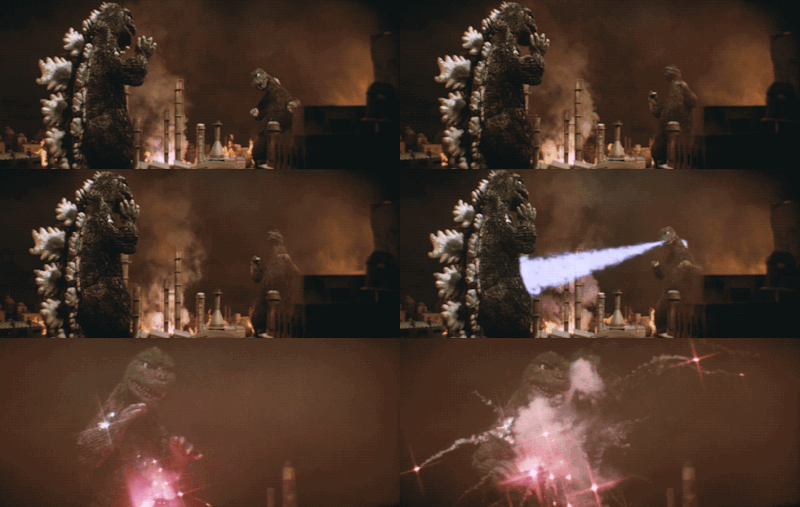
King Ghidorah in Nami’s vision isn’t the only bait and switch; Godzilla appears and attacks Okinawa. Saeko remarks how she never thought the monster that would destroy the world would be Godzilla, and even though he’s a hero now it’s like “Really? He’s still a giant radioactive monster…” Things are even more amiss when he starts fighting Anguirus, and honestly being a real prick about it too! He’s your friend, man! There’s no need to break his jaw! We see a shift in tone that is no longer trying to simply cash in on younger audiences, Godzilla vs. Mechagodzilla is aimed toward a teenage fanbase, and on parents who grew up watching the 50s and 60s kaiju films. It’s not long before we find out that the real Godzilla has emerged to fight this phony. During the battle, Godzilla tears some flesh off the imposter to reveal metal underneath, the same space metal found by Masahiko earlier. Aliens of course have sent down this cyborg to subjugate mankind. Mechagodzilla’s true form is revealed, with some fantastic big band music heavy on drums and trumpets. During the tussle of Godzilla vs Godzilla, they actually used a cheap promotional suit made for public appearances to pit against the movie suit crafted for Megalon and modified for Mechagodzilla.
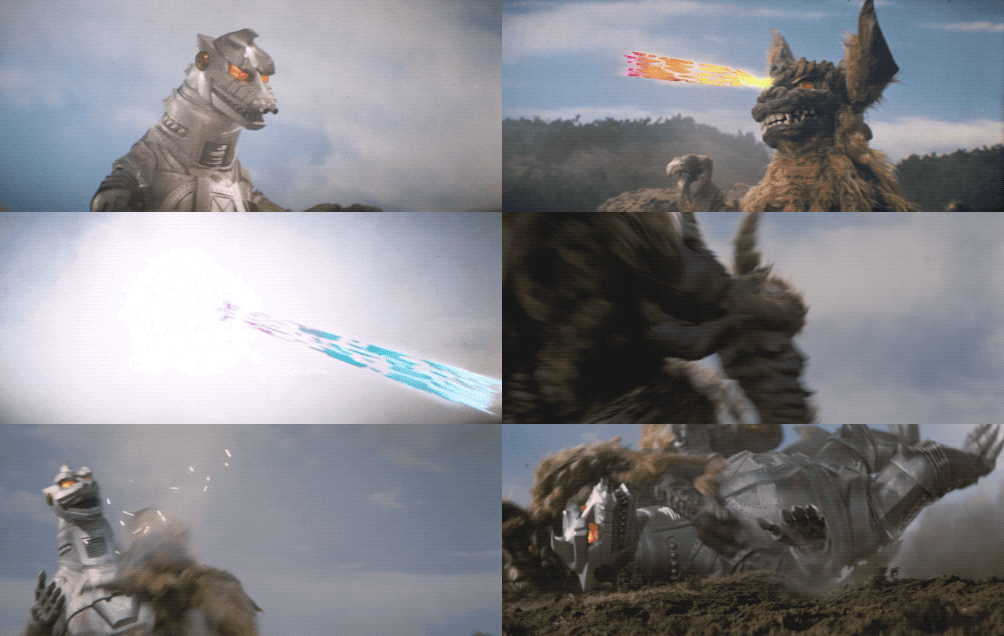
There’s more bait and switch as one of the aliens tries to steal the statue, gets shot, and tumbles into the ocean with it, only to reveal that was a decoy. The aliens seem to be Planet of the Apes knock-offs in disguise. This will not be very important, but it’s there. Our heroes bring the statue to a temple in Okinawa and see the sun “rising in the west,” which ends up being a mirage. The interaction with the statue awakens King Caesar and the final showdown is underway. Let me tell ya, the plot in this one is bland cookie cutter drivel, but King Caesar is a scrappy little kaiju. He’s got these spikes on his head that the put the damage on Mechagodzilla when does some running headbutts. Fukuda was originally going to incorporate another monster like Gigan, but felt that Mechagodzilla was quite the match on his own. You see why when the fight gets going. He’s got a rainbow beam that shoots from his eyes, missiles that shoot from his fingers, toes, and knees, and this god-awful chest bolt that’s cartoonishly animated in post.
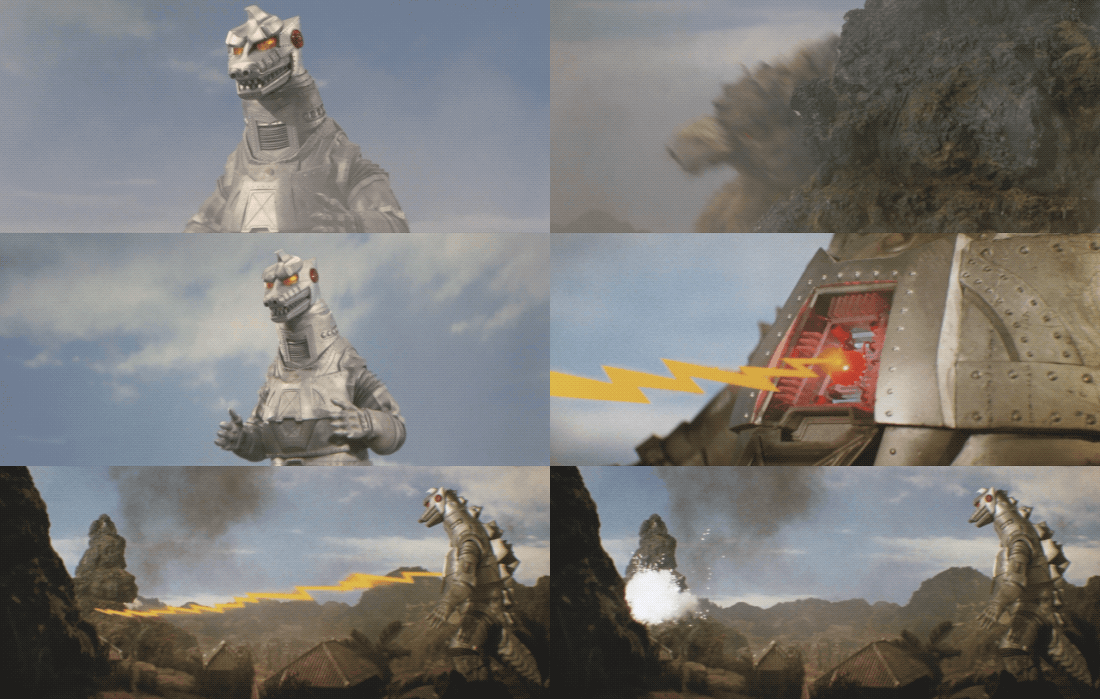
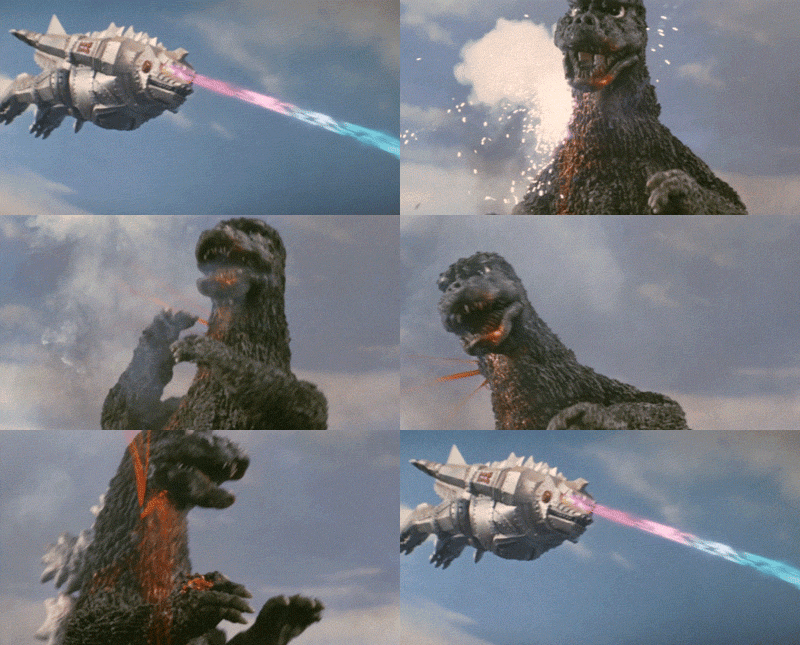
Being a robot, Mechagodzilla can spin his head 360 around, which he does once to attack King Caesar behind him, and another to…initiate a bizarre force field. This dude’s got everything! When he unloads it all at once, you can tell Fukuda and Tanaka are just having fun setting off as many pyrotechnics as they can afford. Mechagodzilla goes into flight mode and really lets Godzilla have it. The blood spray is enormous, and Godzilla is impaled with metal projectiles, which he pops out using the power of magnetism! You see, he was struck by lightning earlier, and yeah this is silver-age Magneto physics. He’s able to just draw Mechagodzilla out of the sky with this magnetism, a feat we’ll never see again. After tag-teaming Mechagodzilla, Godzilla proper twists his head around, which Mechagodzilla has already proven was no problem, but this time it breaks clean off. Whatever works, my dudes!
While Godzilla vs. Mechagodzilla is iconic for introducing one of the biggest antagonists in the series, it’s still a very mediocre film. Masaru Sato’s score adds some distinct flavor, but it seems caught between audiences: too mundane and childish for adult viewers and at times too gory for child fans. It’s worth a once over if you’re interested in first appearances, but not a lot stands out to make this film truly weird or unique. Rest assured, Mechagodzilla will return in the next film, and many more in the future.

 Godzilla Vs...!