
When he wasn’t crafting monster suits for Toho’s Godzilla franchise, special effects legend Eiji Tsuburaya ran his own television production company. You may recall Tsuburaya stepping aside back in 1966’s Ebirah, Horror of the Deep, staying on only in a supervisory role for several films. What became of his pet project after passing the torch at Toho? None other than the beloved Ultraman series that spawned another suitmation genre with hundreds of series drawing from this source material. Ultraman inspired shows like Kamen Rider, and Super Sentai, best known as the production Mighty Morphin Power Rangers used footage from. Eiji Tsuburaya’s legacy is cemented in not one, but two media juggernauts that changed the history of entertainment forever. And it’s that powerhouse of creative force that lead Toho to hold a contest to design an Ultraman-esque robot that would be featured in the next Godzilla film. After a few redesigns (much to the chagrin of the kid that won the contest), this robot would become the both beloved and despised, the android with a plandroid, the polarizing pugilist, the one…and only…JET JAGUAAAAAAAR!
The introduction of Jet Jaguar doesn’t even come close to being the most ridiculous thing in Godzilla vs. Megalon, but he’s emblematic of the film. This is a movie that took 6 months to make, from planning to finish, and shot over the course of 3 weeks. There wasn’t enough time to really write a script, so Shinichi Sekizawa created a basic outline that director Jun Fukuda filled in the dialogue for. It’s probably one of the most hastily, messily made films, with one of the lowest budgets, and like its last few predecessors incorporates an abundance of stock footage. Megalon is at the height of being self-aware, tongue-in-cheek, and giving no fucks too. While Godzilla vs. Hedorah takes the cake for sheer lunacy, Megalon fully embraces its goofy pro-wrestling in monster suits style. In prior films, the suit actors are kind of trying to act animalistic like monsters would, and all that is thrown out the window here. Shinji Takagi, Hideto Date, Tsugutoshi Komada, and Kenpachiro Satsuma all do a bang-up job as Godzilla, Megalon, Jet Jaguar, and Gigan respectively. Godzilla vs Megalon is also the second film to get an American theatrical release (after Godzilla vs “The Smog Monster”), and was pretty widely distributed. Despite its corny production, and a misleading poster of Godzilla and Megalon fighting on top of the World Trade Center towers, it did well in the states. It would go on to be the first Godzilla movie aired on TV during primetime, with host John Belushi in a Godzilla suit providing bumpers around commercial breaks. Sadly, these have been completely lost to the annals of time.
The human drama plot in Megalon is completely bonkers. It opens by noting that nuclear testing is causing all kinds of problems in the pacific, and this pisses off an underwater Atlantis-type nation called “Seatopia.” The seatopians are really something else I tell ya, they take no half measures. And just when you think they can’t get any more preposterous, THEY DO. Before we dive into Seatopia, let’s meet our three heroes: Goro Ibuki, played by Katsuhiko Sasaki, he’s invented the world’s stupidest, most ineffective watercraft, a dolphin with side paddles that are also dolphins that don’t actually seem to move the craft at all. And hey, it’s the kid from Hedorah! Hiroyuki Kawase plays Goro’s little brother Rokuro Ibuki, and man he’s shot up like a beansprout in the past two years. Rounding out the team is Goro’s friend Hiroshi Jinkawa played by Yutaka Hayashi, who is the resident badass racecar driver.
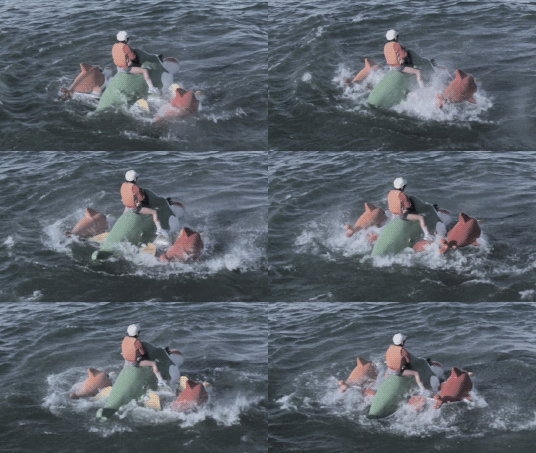
Megalon is one of two movies to get the MST3K treatment and it’s no wonder. Expecially watching the dubbed version. Even the remastered audio is just terrible. If you’re going to subject yourself to this one, watch it in Japanese, otherwise see it getting riffed by the Mystery Science Theater crew. So, after an earthquake our cast drives back to the ol’ Jet Jaguar lab in a 1970 Ruska Classica, really driving home the point that Hiroshi is into cars. When they arrive, two weird dudes with red buttons on their coats have broken into the lab and an awkward fight scene ensues. Everyone is both knocked out and recovers in the swift easy way of 70s cinema. Shaking a barely conscious Rokuro who’s still clutching his neck, Hiroshi says “You’re ok!” and takes off to chase our villains in the Classica. There’s some choppy editing and sped-up film to simulate a more intense car chase, and man do we have some groovy 70s flute music that does not fit the scene at all. Back at the lab, they discover some red sand that’s the “same color” as one of the buttons on the thieves’ coats. Upon examination (in the Honda room, a nice nod to the former director), they find that it’s the same sand as on…Easter Island. Yeah, this will mindbogglingly become important later.
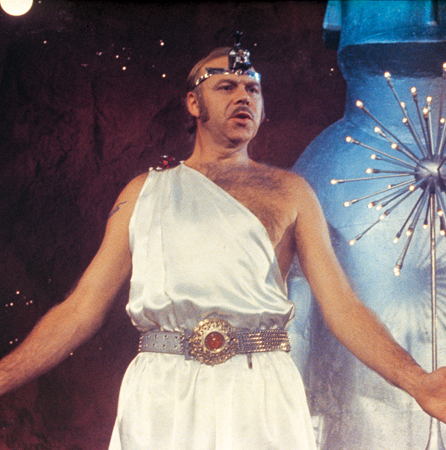
As Rokuro is out riding on his mini-bike there’s a fantastically stupid and brutal scene of the robbers absolutely dooring the kid before abducting him. It is worth the watch just for this. They use Rokuro as bait to get back into the lab, where they use some knockout gas that, I don’t know, they didn’t have with them before? And while phoning home…to Seatopia!…We get a glimpse of their commander, a balding mustachioed dad-bod wearing a white toga and a circlet…with Megalon’s head on it. This man and everything around him is so silly. Seatopia seems to have a very cheap casino vibe, and the external matte painting rendition of their location implies that this is also a hollow-earth situation, so fans of the current Monsterverse series can trace this plot thread back to Fukuda’s tremendous shitshow of a movie Godzilla vs. Megalon. The basic premise of the plot is Seatopia is sick of Earth’s reckless nuclear tests and sends Megalon surface-side to teach us a lesson. For some reason, they want the Jet Jaguar robot to guide him to their targets.
Upon activating Jet Jaguar, he leaves the lab, walks down some steps, and then flies off. Dude, why did you need to walk down those steps? Everything about Jet Jaguar is cheap and goofy. He’s got this grate for a mouth that is constantly grinning. His eyes are blue-tinted car taillights. His suit is obviously a ton of foam, not metallic at all. And Riichiro Manabe’s theme music is upbeat and extremely dated. Megalon’s design kinda rules too, he’s essentially a giant cockroach with drills for hands and he shoots lasers from his antenna and explosive balls out of his mouth. We find the Seatopian robbers have shoved Rokuro and Goro in a shipping container and the plan is to dump them in a lake. While driving the container around in a cargo truck, these two suffer so many head injuries, so many. Luckily as they’re being dumped, Megalon gives them the alley-oop which should really have killed them both but just sets them free. This scene also features the majority of the practical effects budget as Megalon bursts through a dam. While effects director Teruyoshi Nakano didn’t have much to work with, he did want to invest in at least one impressive shot to remind audiences how amazing monster movies could be, and give them a taste of something you wouldn’t see on TV.
Hiroshi gets himself into another car chase, him being a racecar driver as the movie constantly wants to remind us. This time it’s in a 1966 Volkswagen 1600-TL and this one goes off the rails (or road as the case is). While being pursued, Hiroshi takes the car off road and down some stairs. Inspired by the original Italian Job maybe? When that doesn’t shake the culprits, he figures to one-up the stairs and drives into a freakin rock quarry, finally shaking the Seatopians by driving through a shack, collapsing it behind him. That’s one tough Volkswagen!
When the army assembles to stop Megalon, leaning heavily on military and model stock footage, the music Riichiro Manabe uses is surprisingly tight with a solid beat; I’m honestly surprised it hasn’t been used on a Wu-Tang track. Goro regains control of Jet Jaguar, so in response, the Seatopians, I kid you not, use the heads of Easter Island as radio transmitters to summon Gigan! This movie is totally insane and I’m here for it.
The suit actors are great in their own right in Megalon, bringing a lot more quirks and personality to the monsters. From Jet Jaguar’s stiff, robotic movements to Megalon’s bouncing and posing, to Godzillas entrance, hyping himself up like a titleholder approaching the ring, each actor brings something special to the screen. Fukuda is fantastically aware of the effects limitations, designing Megalon’s laser to be crackling yellow so they could re-use footage of Ghidorah’s beams destroying cityscapes. This poor Mobiloil station has gotten wrecked by those beams around four times already! Directly after an encounter with some military planes, Hiroshi and Rokuro stop by a model shop and the camera focuses on the exact type of plastic aircraft we saw fighting Megalon fighting moments ago. (Their plan is to fly a remote controlled plane right into the face of one of the Seatopians and it is way more effective than it should be, gushing a facefull of blood). Jet Jaguar becomes a very obvious Ultraman knock-off when, by sheer determination, he grows to the size of a kaiju, and they use a similar effect of fading progressively taller stills into the shot.
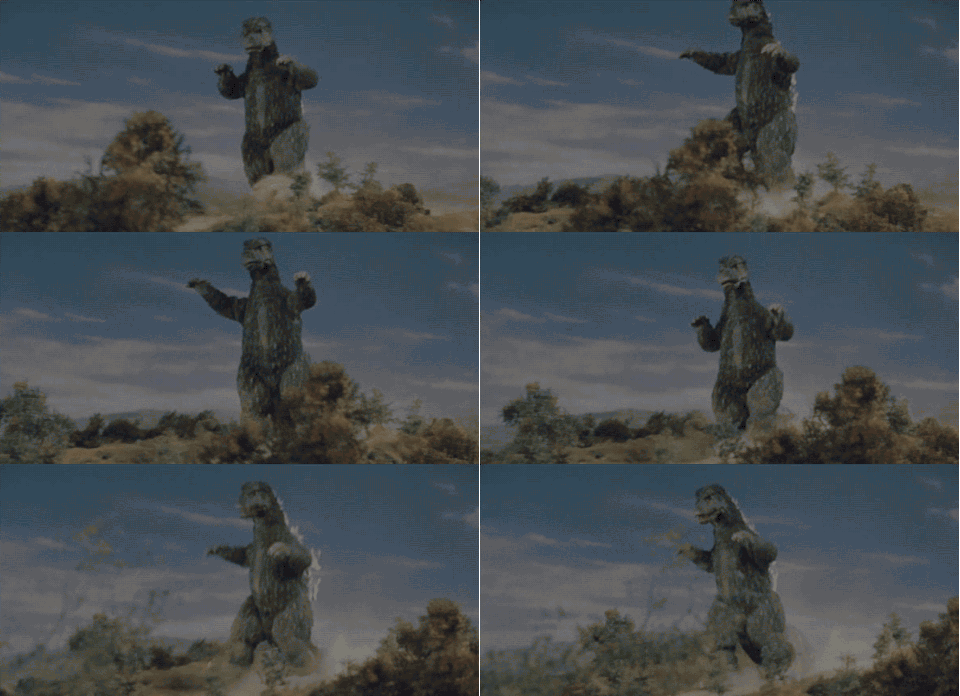
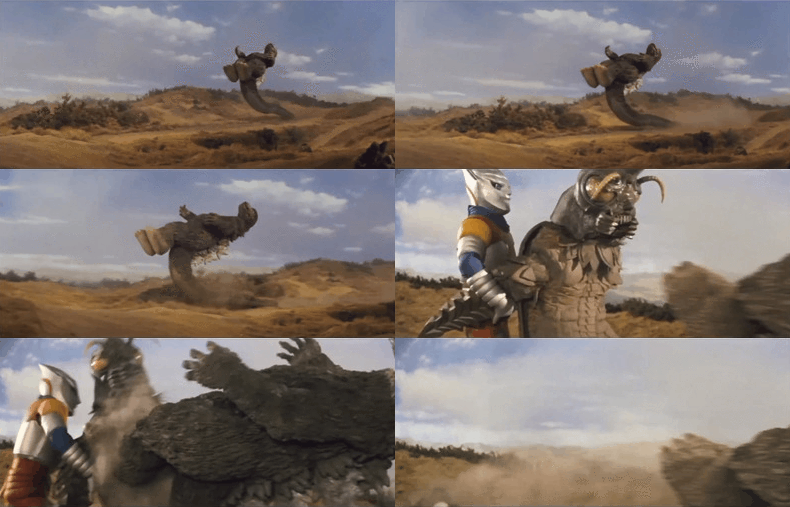
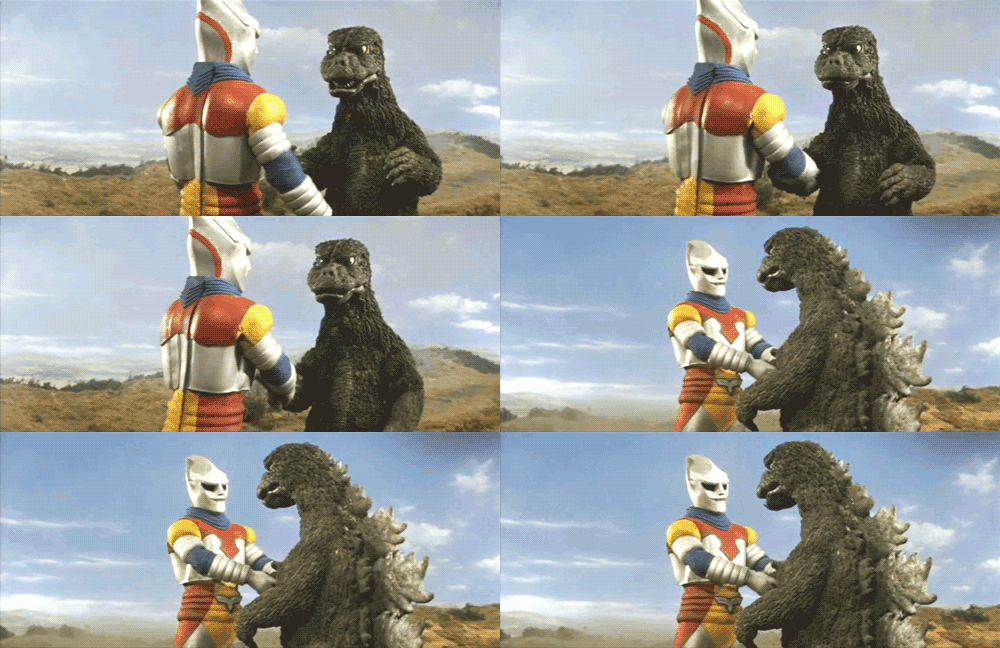
The main event is mad fun with plenty of wirework (that you can absolutely see). In one bit, Megalon flies circles around Jet Jaguar, who is a robot mind you, and makes him DIZZY. Gigan’s bloody buzzsaw shot is brought back here, and long-time viewers may note that Godzilla picks up a move King Kong pulled on him, trying to shove a tree down Megalon’s throat. Godzilla and Jet Jaguar do a great job as a tag-team, at one point fighting back to back in a ring of fire. Jet Jaguar gets the drop on Megalon, pinning his arms behind his back, and then another famous cheesy move: Godzilla does this nutty jump-kick, flying all the way across the screen, and then he does it a second time! Note: they only filmed this stunt once. The whole thing is a goofball affair that’s set aside any pretensions of having a substantive message. Megalon is squarely aimed at kids, and everyone’s having a heck of a time. It’s understandable why so many fans dislike this one, but if it weren’t for the kids begging parents to go to the movies to see Godzilla, the franchise would be dead in the water at this point. Megalon hopped so Biollante could run.
Godzilla vs. Megalon is inarguably a low point in the series. It has nothing to say to the audience, it’s made for children, there’s choppy editing and a mountain of stock footage. Gone are the days of laying waste to intricately constructed city buildings, we’re fighting squarely in the ring of barren landscapes. It’s one of the only Godzilla movies that doesn’t have any female characters. But though Godzilla is changing, it’s not all for the worst. It meets the business challenges of the 70s head on, and has a grand time of it. It is wholeheartedly earnest in this new shift in tone. I think we can all learn a little from Godzilla vs. Megalon. Through tough or depressing times, when there’s not a lot to go around, you can still make something joyful and have a blast doing it.
 Godzilla Vs...!