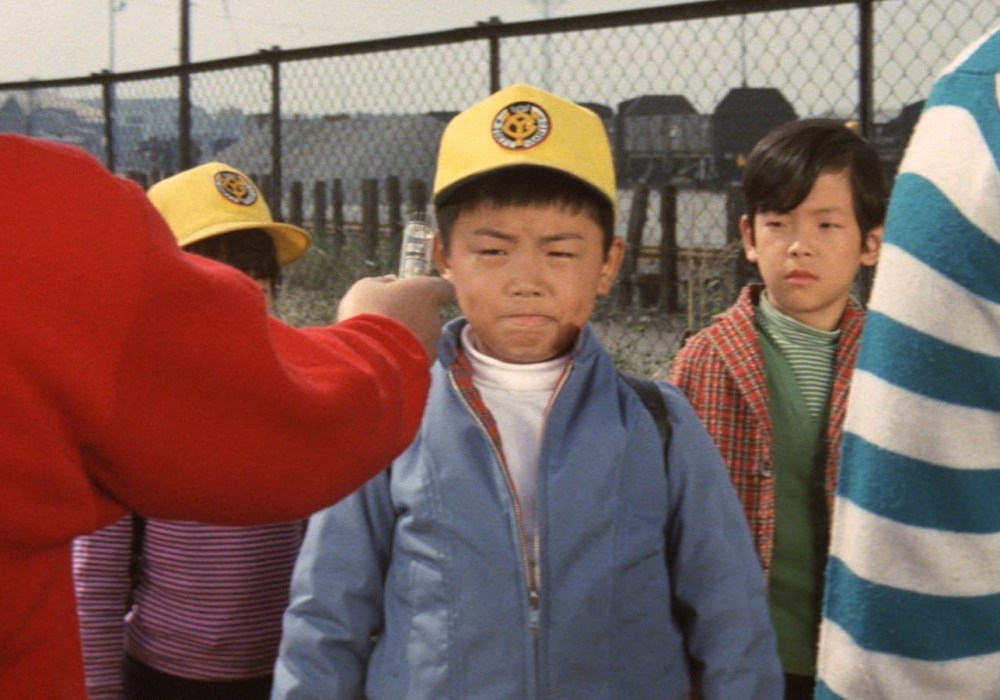
All right haters, bring on the tomatoes! All Monsters Attack is good, and you should all feel bad about hating it. In 1969, Japan was in the midst of an economic boom. Long since merely recovering from the war, government policy had been focused on, and succeeding at, doubling the size of their economy. Industrialization and social safety nets transformed Japanese life from just getting by to having more disposable income to spend recreationally, and the US’s partnership offered an enormous market for exports. Would they have been so successful if the US hadn’t been trying to combat communism? Foreign aid and trade deals were given as a way to ensure that Japan was a success story in spreading democracy, and that its citizens did not become disgruntled, impoverished, and susceptible to Soviet influence. With all this though came a social epidemic: the latchkey kid. Many families became two-income households, and children were often left to their own devices after school. All Monsters Attack is a meta-film that uses kaiju as an escapist backdrop while wrestling with feelings of loneliness and anxiety, and learning the importance of self-reliance.
Going into this, you should realize that All Monsters Attack is an outlier, not your average kaiju eiga. It doesn’t take place within the continuity of the rest of the franchise, instead being set in the real world, and visiting Monster Island through imagination and dream sequences. After 1968’s Destroy All Monsters, Toho’s plan was to collaborate with an American company to produce an animated series while putting all Godzilla films on hold. The deal fell through, but the company was working on putting out a line of kid-friendly films, and decided to include this oddball of a Godzilla concept in the mix. With the financial pressures already prevalent before Destroy All Monsters, and theater revenue down, there was no way Toho could produce a legitimate monster movie. On an incredibly scaled down budget, Ichiro Honda returns to produce the heartwarming tale of Ichiro Mitsuki, played by Tomonori Yazaki, a latchkey kid who has to deal with local bullies and dangerous bank robbers. Ichiro’s love of kaiju sends him dreaming of Monster Island to get away from the boredom and frustrations of his young life, and the majority of these scenes are recycled footage from Ebirah, Horror of the Deep, Son of Godzilla, King Kong Escapes, and Destroy All Monsters. If the over use of stock footage, and the meta concept are dealbreakers, I don’t necessarily blame you. But this film has enough heart to overcome the setbacks.

One of the strongest things All Monsters Attack has going for it is the soundtrack, which assaults the viewer immediately with the theme song…which has lyrics. Musically, it’s a deliciously late 60s Japanese infused Bossa Nova tune and the vocalist Lily Sasaki has a rough gravelly delivery with low plosive notes that embodies monsterdom. It’s sung from the perspective of monsters, with voice and personality similar to when the Shobijin translated for Godzilla and Rodan in Ghidorah, the Three Headed Monster. Lyrics include “Why is Earth such a hard place to live?” which gets more relatable each year, and “Smog is the real monster,” foreshadowing the next entry. Kunio Mayauchi was brought in to score this one and really shines throughout.
We meet Ichiro on his way home from school, he passes his father working in the railyard, gets punked by some bullies led by a boy named Gabara, and his friend’s mother passes by warning him to go home and not get drawn in to a bad crowd. The camera angles are down low and relate the shorter children’s perspective; you’re brought into Ichiro’s world and Tomonori does a fantastic job throughout relaying the childhood experience. You tangibly sense his forlorn lonesomeness, and when he delves into the fantasy, paired with Mayauchi’s soundtrack, you can feel his longing for an exciting better life. This is someone with few friends, left alone for hours each day, who has to make his own entertainment.
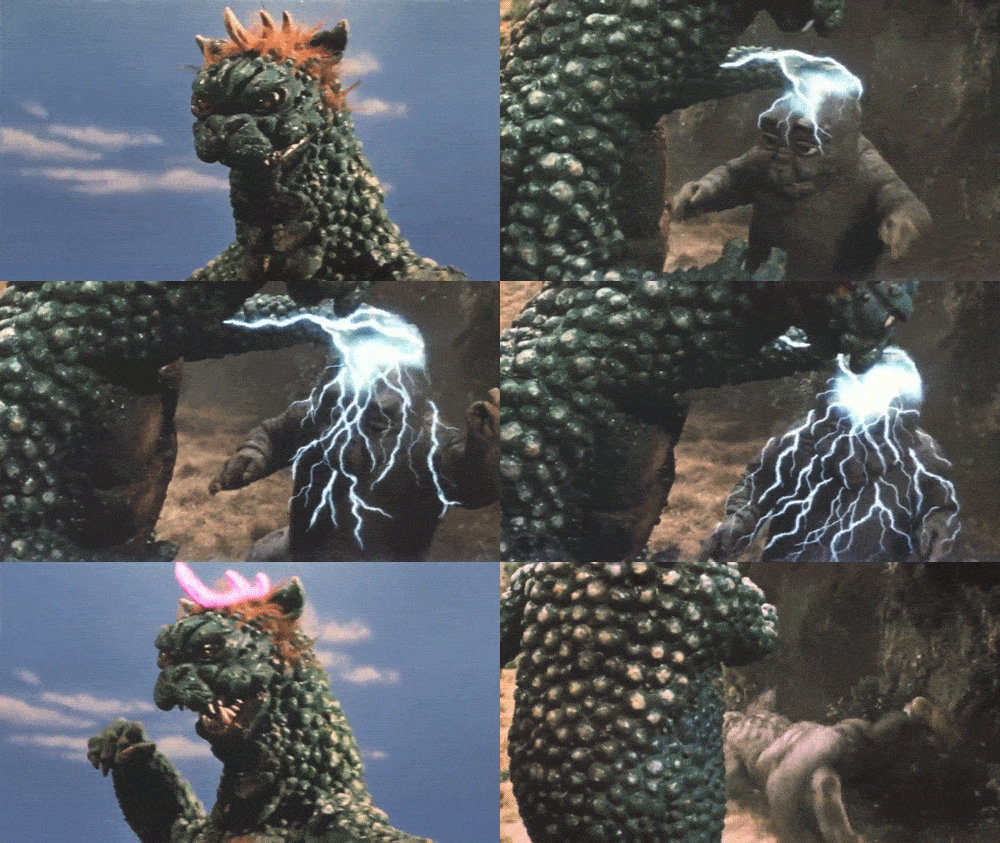
In this fantasy world, he meets Minilla, who actually talks, swearing he won’t hurt him. Ichiro in turn asks if he can be sure, and Minilla responds “we don’t lie like humans do” -damn Minilla, sick burn. It turns out Minilla has a bully named Gabara too, and he’s not strong enough to fight him. Over the course of the film, Minilla learns to stand up for himself, and by extension so does Ichiro. In the real world, he ends up getting kidnapped by bank robbers on the run. On his own in a terrifying situation, he musters bravery and wits to escape, calling back to Minilla’s arc in his own.

As a monster movie, All Monsters Attack isn’t great in comparison to other Godzilla films, especially due to its heavy use of recycled scenes. It’s kind of hilarious seeing how Honda and co-special effects director Teruyoshi Nakano try to insert things like trees and rocks in the foreground to make it seem different or hide parts of the original. If you can get past that an accept it for what it is, All Monsters Attack is a heartfelt story of childhood and growth. Tomonori Yazaki is tremendous as a young actor, and we rarely see any kind of real character arc in other Godzilla films. Between this and the music, it makes All Monsters Attack an undervalued entry in the series. How people enjoy Son of Godzilla over this one, I’ll never know. I’ll make no apologies for this undeservedly reviled film, it’s one of Honda’s favorites, and if you’ve got young ones at home, this could be a great introduction to Godzilla for them.
 Godzilla Vs...!