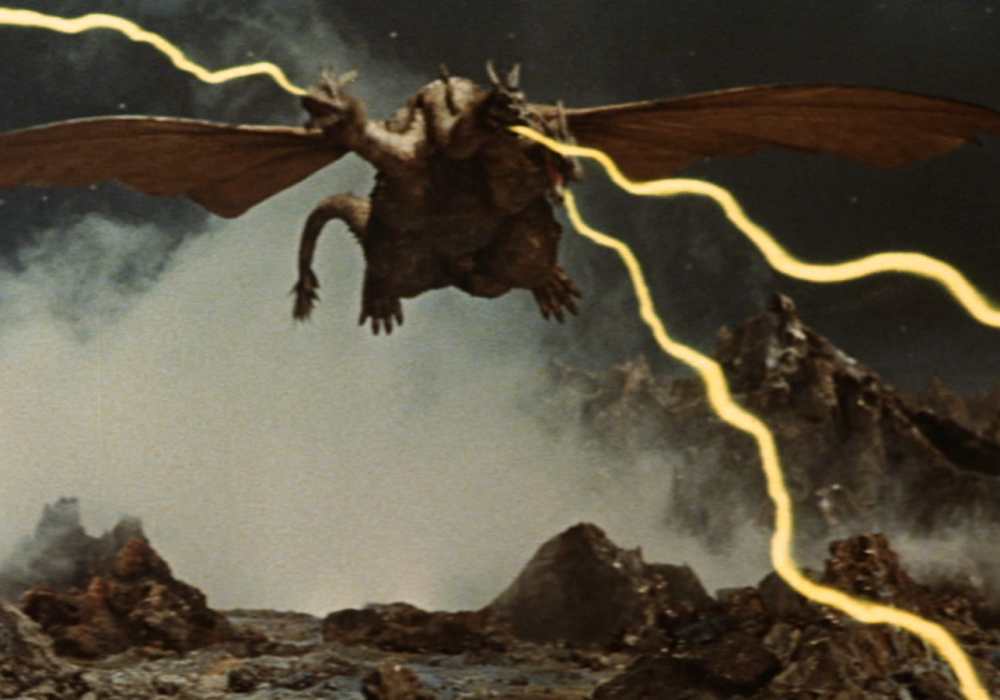
In 1964, we received a strong message on the importance of international cooperation in Mothra vs. Godzilla, and a year later Toho Studios was practicing what they had preached. Invasion of Astro-Monster was one of three co-productions with US producer Henry G. Saperstein, who claimed to provide half the funding, yet budget restrictions still forced a few shortcuts along the way. In spite of these, Invasion of Astro Monster is a fun beautiful romp and the first in the franchise to introduce an alien race. There’s a whole lot of sci-fi DNA throughout the film, so if you’ve branched out beyond the Godzilla franchise, you’ll recognize some nods to those who came before.
A large portion of this film is set on Planet X, and let me tell you: everything about these scenes from top to bottom is absolutely gorgeous. Special effects director Eiji Tsuburaya is at the top of his game crafting rocky otherworldly landscapes aided by well-designed deep space backdrops. The interiors are marvels of retro-futurist construction, and the Xilien costume design with wraparound sunglasses and antennae is the epitome of 1960s sci-fi unearthly goofiness that I wish we could get back to.
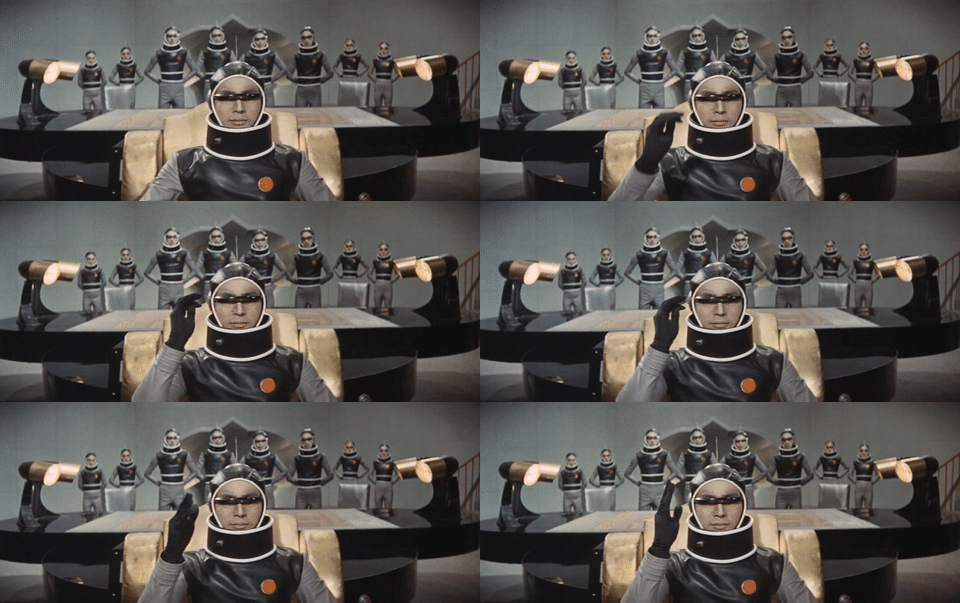
Ishiro Honda returns and does a stellar job directing this interplanetary masterpiece. Here, he builds on his experience with 1957’s The Mysterians, a Toho alien invasion film that inspired the 1968 cult classic Mars Needs Women. The latter title sums up the plot of The Mysterians and lucky for us Invasion of Astro-Monster is substantially less gross. Being an American co-production, US actor Nick Adams was cast to play astronaut “Glenn,” a nod to John Glenn who became the first American to orbit the earth in 1962, just three years earlier (a year after Yuri Gagarin –the US was lagging behind in the space race at this point). Honda would sit out the next two Godzilla films; it’s unclear whether this had anything to do with the infamous victory dance, or the decision to anthropomorphize the monsters, but don’t fret fellow viewers, Honda will return for Destroy All Monsters, and All Monsters Attack.
Both the American version and Japanese version are readily available, and this is one of the few entries where the American version isn’t too bad. Nick Adams’ performance is worth the watch, and the rest of the dubbing is pretty good as a result of Saperstein’s involvement. There aren’t many scenes cut and Akira Ifukube’s score is left mostly intact, something that can’t be said for most translations (the biggest exception being the “Frigate March” in the opening credits being replaced by more a more run of the mill spooky outer-space theremin intro).

Contrary to the title, there’s really nothing called Astro-Monster in the movie, but it’s obviously meant to allude to King Ghidorah. It opens with a pair of astronauts on a mission to newly discovered Planet X, where they discover the existence of a mysterious alien race: the Xiliens. Akira Takarada (Godzilla, Mothra vs. Godzilla) plays Kazuo Fuji alongside Nick Adams’ Glenn. When they first touch down on this Planet (actually the 13th moon of Jupiter, in the American release), there’s an amazing shot of one of the astronauts slowly riding a lift to the surface, then when he gives the all-clear, they recycle the same slow shot even though there was clearly room enough for two on this platform. It’s a very “we BUILT the model, we’re going to USE the model!” moment. The astronaut’s ship, the P-1, was over 3 meters tall, the crew wanted a low-angle shot to show it off, but it would have caught the top of the studio set in the process. Special effects art director Yasuyuki Inoue broke a hole in the floor to be able to show the full rocket taking off from a submerged hangar and got in trouble for it, but that didn’t stop him from doing it again in Destroy All Monsters. Mad respect!
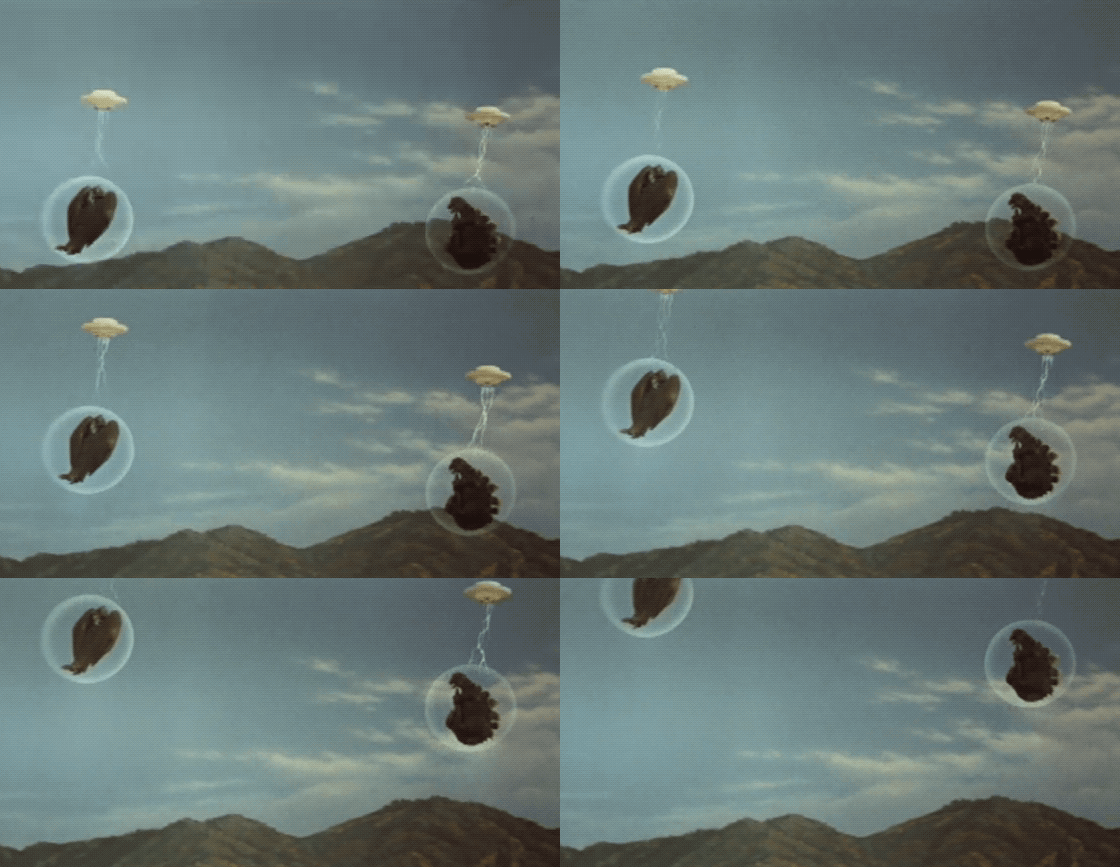
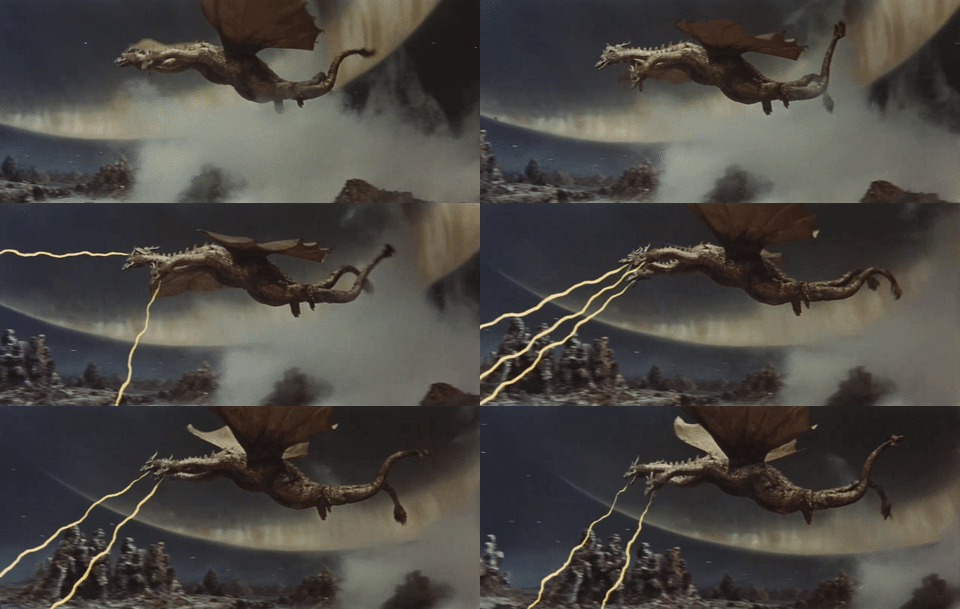
Back on Earth, we follow lab assistant and Kazuo’s sister Haruno Fuji (played by Keiko Sawai), who’s dating inventor Tetsuo Torii (Akira Kubo). Tetsuo has invented what’s essentially an electronic rape-whistle called the Ladyguard (that would have been useful in the The Mysterians!) which is bought by businesswoman Namikawa, who happens to be dating Glenn, (and they were all in love with dyin’/They were doin’ it in Texas). On Planet X, the Xiliens explain they’ve been plagued by King Ghidorah, who they call Monster Zero because apparently they number everything instead of naming them. Ghidorah makes an impressive entrance flying through a cloud of fog and blasting everything in sight. The Xiliens have one request: put Godzilla and Rodan out to them on loan in exchange for a cure to all disease. Seems like a fair trade right? What could go wrong?
Earth holds a conference and agrees to the terms, so that means we get a rad space battle on Planet X, where the Earth monsters emerge victorious. Godzilla jumps up and down in a hilarious dance that would later prompt Ishiro Honda to scoff “I did not create Godzilla for this.” Now, the Earthlings have found themselves in a pretty clutch situation: not only are they receiving a miracle drug, but they’ve rid the world of two giant monsters. The astronauts leave them on Planet X and it’s genuinely sad.

Lo and behold, when the humans play the tape that’s supposed to have instructions on how to create the miracle drug, they’ve been double-crossed! There was no cure! The Xiliens plan on colonizing Earth and harvesting our water. And if we don’t comply, they’ve got a mind-control device and plan on unleashing the three monsters to crush us into submission. Incidentally, Glenn asked if this very device they used to control their ships could be used on animals earlier in the film, completely out of the blue. You should’ve seen this coming, Glenn.
During the rampage after the monsters are brought back to Earth, budget restraints led to the effects team recycling some former shots from Rodan, Mothra, and Ghidorah, The Three-Headed Monster. Honda was caught in a Catch-22 where they had to meet tight budgets, but if they recycled shots, fans would stop coming, and then the studio wouldn’t think effects films sold tickets anymore. Anywhere you see buildings destroyed is recycled, which isn’t too bad watching it as a standalone film, but one scene in particular features the original Rodan suit that is just straight up not even close to looking like the one used in the rest of the film.
On top of borrowing a lot from The Mysterians, the humans lean on an age-old sci-fi trope of something relatively innocuous defeating the invading aliens. In H.G. Wells’ War of the Worlds, it’s germs, in 1956’s Earth vs. The Flying Saucers it’s sonic interference, and Astro-Monster‘s solution to the Xilien menace is the frequency emitted by Tetsuo’s Ladyguard. This will also be satirized in criminally under-appreciated 1996 film Mars Attacks! where they broadcast yodeling to destroy the martian menace, and if you haven’t checked that one out: do yourself a favor!
All cost-cutting measures aside, Invasion of Astro-Monster is a top-notch entry where the effects team got to go hog-wild in space. The drama, intrigue, and mystery that the Xiliens bring is deliciously pulp and brings a fresh angle to the kaiju genre. A lot of Honda’s shots on Planet X are well-crafted; even in a film that pissed him off, he brought his A-game. And with that, I leave you with the dreaded Shie Victory Dance:

 Godzilla Vs...!